I Ran Out of Patience for Public Opinion by the Age of 8
This article first appeared on Substack at https://jacoporomei.substack.com/p/i-ran-out-of-patience-for-public.
Several times a day, I open Instagram, start scrolling, and within a minute the questions begin.
Why am I looking at yet another opinion built on no facts at all? Why is someone reopening an argument that was written down, examined and settled a hundred and fifty years ago? Why are people defending retrograde views that, quite often, I’m not even convinced they privately believe or live by?
The easy explanation—we hear it constantly—is that the platforms did this. Facebook, Instagram and “The Algorithm” took ordinary human weaknesses, amplified them and somehow produced this mixture of ignorance, aggression, tribal loyalty and confident resistance to reality.
It’s an appealing explanation. Above all, I think, it’s because it gives us a machine to blame.
I don’t fully believe it.
I remember feeling almost the same frustration by the age of eight. The same contempt too, if I’m honest—a feeling that isn’t especially noble, I know that. But it was already there, fully formed, long before there was any feed to scroll through.
Three episodes from that period came back to me recently. Together, they explain exactly what I mean.
Three ways to deny reality
The Teacher and the Rotating Sun
When I was in second grade—seven years old—I was fairly obsessed with astronomy. I read books written for children and, whenever I could make sense of them, parts of the ones written for adults too.
One day our science teacher explained that the Earth orbits the Sun, while the Sun remains still.
I knew that the Earth moved around the Sun, and I understood that the Sun could be considered stationary relative to the Earth’s orbit. But I also knew that it wasn’t stationary in any absolute sense. Apart from moving through the Milky Way and carrying the rest of the Solar System with it, the Sun also rotates on its own axis.
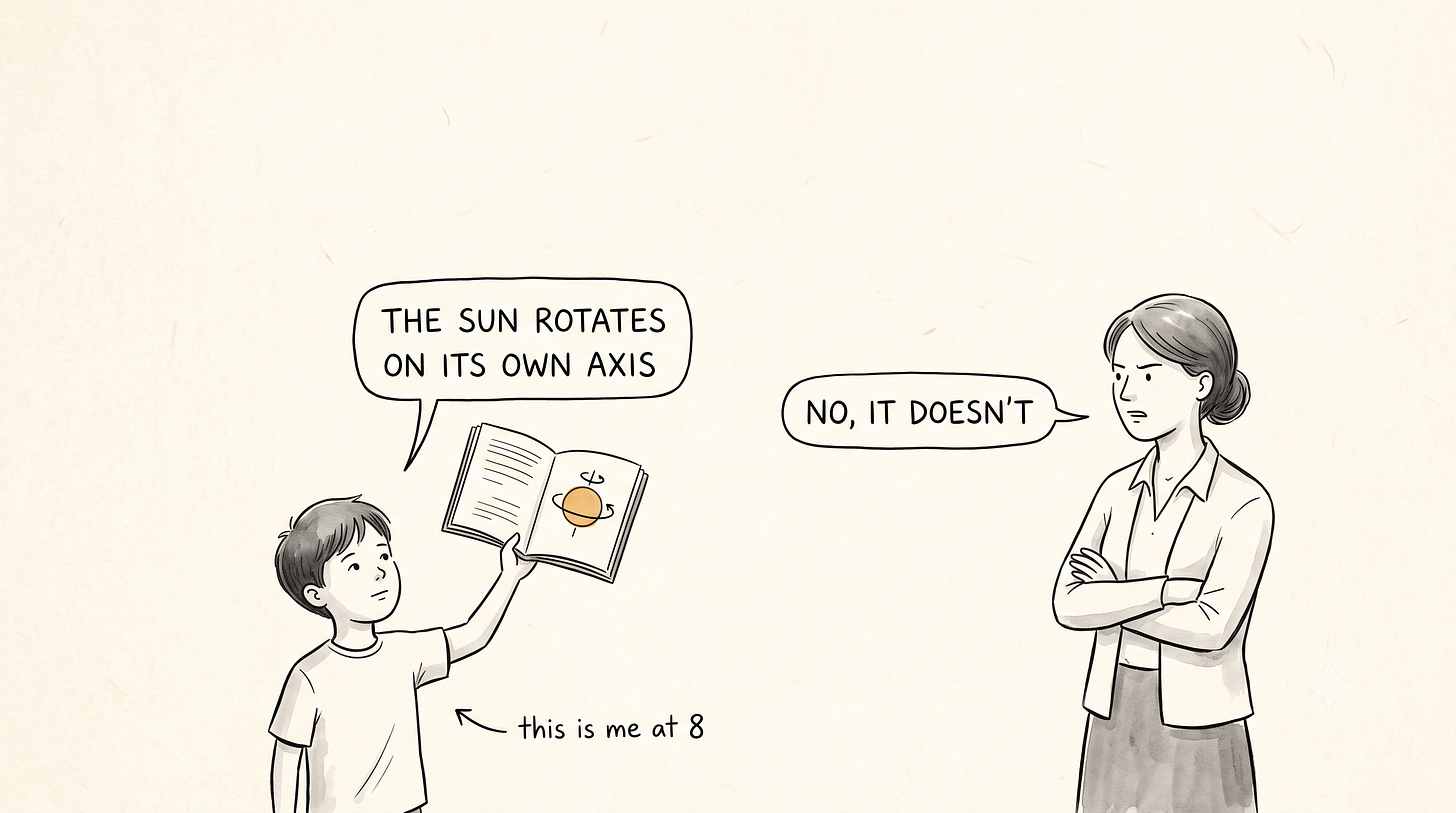
So I raised my hand and said: “The Sun rotates on its axis.”
The teacher didn’t stop to check. She didn’t ask, “Are you sure?” or “Where did you read that?”
She simply replied: “No, Jacopo, that isn’t true. The Sun stays still.”
I went home annoyed enough to look for the source. It didn’t take long. I found the passage in an astronomy encyclopedia I had been reading, and the following day I brought the book to school.
I opened it to the right page, showed it to her and said: “Look. It says here that the Sun rotates on its axis.”
At that point she could have admitted that she had made a mistake. Nothing dramatic. She could have adjusted her explanation, or simply acknowledged that a seven-year-old had brought her a piece of information that changed the picture.
Instead, she started looking for a way out.
She read the page and said: “Well, only the outer layers rotate. And they rotate at different speeds depending on latitude.”
That is true. The Sun rotates faster near the equator than it does near the poles, but she wasn’t offering that distinction because she had known it all along. She was using it because it allowed her to avoid the words she apparently could not bring herself to say: I didn’t know that. You were right.
I wasn’t particularly angry that she had been wrong about the Sun. What stayed with me, even years later, was the missed opportunity. Standing in front of her was a seven-year-old who had gone home, checked a source, and returned with evidence. That is precisely the habit you want to encourage in a child.
The ideal response was very simple: “You’re right. And look at what just happened—you brought me a source and changed my mind. That’s how science works.”
Instead, she defended a position that, by then, had nothing left supporting it.
The Morning Prayer
That same year, my Italian teacher began making the class pray every morning when we arrived.
This was a public school: a secular institution, in a country whose constitution says so explicitly, financed through everyone’s taxes—including those paid by every Muslim, Protestant, agnostic, or atheist parent, by those with no interest whatsoever in religion at all, and even by the practising Catholics, some of whom would still rather a secular institution kept the religion business out of it.
Still, every morning, the entire class prayed together.
Thinking about it all these years later, two questions come to mind.
The first is: Were you stupid?
Did it honestly never occur to her that there might be even one child in that classroom for whom this did not fit? Did she simply assume that everyone sitting in front of her belonged to the religion she had in mind?
The second is: Were you just an asshole?
Because even if she assumed that we were all Roman Catholic, did she feel no hesitation at all about imposing a religious practice inside an institution that was supposed, by definition, to be secular?
The first possibility is a failure to notice other people. Serious enough. The second is worse: seeing the issue and deciding that your own convictions matter more anyway. As it happened, there was a child in the room for whom the prayer didn’t fit. It was me. My parents were Buddhists, and I hadn’t even been baptised.
I went home and told my mother what was happening. The following morning she came to school and explained that the prayer could not be mandatory, and indeed it stopped.
But I learned something else in the process: asking for a right already guaranteed to you does not mean people will treat the request as legitimate. I hadn’t asked for a special exception. I had asked for exactly what the constitution already promised.
Yet that wasn’t how it was perceived. I wasn’t the child pointing to a written right. I became the difficult child, the pain in the neck, the one who couldn’t simply let things go. The one who had to make everything complicated.
Children Come from Marriage
The final episode happened around the same period. It was one of those less structured moments in class, when everyone had gathered around the teacher’s desk instead of sitting at their own. We were talking about families. A beautiful moment, actually.
While talking about mine, I mentioned, without giving it any particular importance, that my parents weren’t married. A boy on the other side of the desk stared at me, genuinely confused, and replied in Roman dialect:
“Se vabbè, e allora te come sei nato?”
The particular Roman swagger of the sentence is difficult to carry over into English. The closest version would probably be:
“Yeah, right—so how the hell were you born, then?”
I began to answer because, by eight, I had already been told how children were actually conceived.
Not in explicit detail, obviously, and certainly not in a way that was inappropriate for a child. Just accurately, in a form I could understand: people have sex, and that is how babies come into existence; marriage is a separate matter; love is another matter again.
I understood that marriage was not some magical rite that manufactured human beings. I wasn’t allowed to finish my answer.
The teacher stopped me. She intervened to prevent me from saying the accurate thing aloud.
“We don’t talk about that.”
The correct answer was available. A child was giving it calmly and in an age-appropriate form. It was shut down not because it was false, but because it disrupted the accepted story.
The boy who asked the question wasn’t the problem. He was asking sincerely and he truly believed that a child could not be born outside marriage because the explanation he had been given was that babies arrive when a mother and father love each other. That wasn’t his fault.
The problem was with the adult who, when given the chance to let the accurate version stand, chose to protect the script instead.
What Was Actually Happening in Those Three Stories
Those three episodes bothered me for different reasons. Looking back, I can now give each of them a more precise name.
In the first, the problem was the teacher’s refusal to revise a wrong idea once the evidence was sitting in front of her. She had begun with a claim. I had challenged it. Then I went home, found a reliable source and brought it back to her. At that point, the question had been settled—or at least it should have been. Instead of changing her mind, she searched for a technicality that would allow her to remain, somehow, right. That is stubbornness disguised as knowledge: not simply being wrong, but treating the admission of error as more threatening than the error itself.
The second episode was about blindness to other people’s rights. My teacher behaved as though her own religious assumptions were simply the natural background of the world. Catholic prayer was not presented as one practice among others. It was treated as the default, something so obvious that anyone who objected to it became the exception—and, inevitably, the problem.
You see this mechanism everywhere. A person takes what is familiar to them and mistakes it for what is universal. Then, when someone points out that the supposed universal does not include them, the person asking to be included is accused of making things unnecessarily difficult.
The third episode was about protecting tradition from reality. The boy believed that children came from marriage because that was the story he had been given. When I tried to replace that story with a more accurate one, the teacher stopped me—not because what I was saying was false, inappropriate or beyond what a child could understand, but because it disturbed a socially convenient fiction. The truth created discomfort, so the script won.
Different episode, same reflex: when reality fails to match the accepted image, correct reality.
Once you notice that reflex, it begins to look very familiar.
So Is It All the Platforms’ Fault?
No.
Around 1990, when these episodes took place, there was no Instagram feed, no engagement algorithm and no comment section encouraging anyone to become more aggressive. Yet the underlying behaviour was already there.
People were already defending positions after the evidence had collapsed beneath them. They were already confusing their own assumptions with everyone else’s reality. They were already protecting comforting stories from inconvenient facts.
This does not mean that platforms are harmless. It means they cannot be the original cause of something that was plainly happening before they existed. What they changed was the scale and the visibility.
Before the feed, public opinion travelled through a very different system. For most of the last century, if you wanted to speak to an entire nation, there were essentially two megaphones, one after the other: first radio, then centralised television. Both were funded, to a significant degree, with public money.
A relatively small number of people, working from a handful of studios, decided what everyone else would watch and hear throughout the day. In Italy, at least, this meant decades of a very particular kind of rubbish being selected above your head and handed down to you.
It was broadcast in the most literal sense: one-directional, centralised, largely beyond your control. You watched what was on.
Social media broke that system apart.
Now, given comparable quantities of rubbish—and I think the quantities are at least comparable—I prefer the decentralised version. At least today the rubbish rises from below instead of being chosen for me inside a studio. I get to see who is actually out there. For better or worse, I know who I’m dealing with.
Are social platforms more polarising? Yes. Obviously.
There is material online that is more extreme, more dishonest and more poisonous than almost anything centralised television would ever have broadcast. There is no point pretending otherwise.
But the same decentralisation that allows the worst material to surface also gives me things television never offered me in fifty years. It gives me Veritasium unpacking a thorny problem in physics and THE RACE giving me the latest news, analysis and opinions on all things F1.
And those are only two famous examples in a couple of fields. There are hundreds of thousands of highly specialised, genuinely excellent channels in almost every field you can name.
That is the trade-off.
The price of decentralisation, of finally being able to choose and of gaining access to all those narrow pockets of excellence, is that you also gain access to everyone’s opinion about everything. And once all those opinions become visible, you can count them.
The real question was never simply whether social media is good or bad. The question is what we do with what the mirror shows us.
The Spread of Ignorance
Whenever I say that this kind of ignorance is widespread, someone eventually replies: if it is so common, doesn’t that make it normal? Perhaps even inevitable?
Careful. There are two different ideas hiding inside that word.
One is descriptive: normal as in typical, average, or statistically common. In a normal distribution, mean, median, and mode coincide, so what is “average” also sits at the center of what occurs most characteristically.
The other face is normative. Normal ultimately comes from the Latin norma: a rule, a standard, originally even a carpenter’s square—the tool used to establish what is straight and correct.
So the word quietly moves between two very different claims: this is what usually happens, and this is what is supposed to happen. And we often slide from one to the other without noticing.
As a corollary, something can be normal in the sense that it happens frequently without being normal in the sense that it should be accepted. The fact that many people behave in a certain way tells us how common the behaviour is. It tells us nothing, by itself, about whether that behaviour is right.
Ignorance can be understood. It was perhaps easier to excuse decades ago, when access to information was much more limited, and it is far harder to excuse now. But understanding why something happens, or why it spreads, is not the same as approving of it.
And look at the kind of ignorance involved in the three episodes I described. None of it was the honest kind, the simple and perfectly respectable: “I don’t know.”
It was ignorance presented as knowledge.
Not: “I didn’t know the Sun rotates.”
But: “No, what you are saying is wrong”—said in the face of the evidence.
That is the kind of ignorance that corrupts. And it spreads because we excuse it through a series of small concessions.
Come on, the teacher got one thing wrong. It’s not a big deal.
Or: It’s only a prayer. It’s only a crucifix on the wall.
Every “only” adds another link to the chain, and each one looks almost costless on its own. Nothing terrible happens because of one wrong answer, one prayer or one comforting fiction.
You don’t see the consequences after a week or a month. Over several decades, though, you end up with a society that has gradually lost some of its ability to distinguish evidence from conviction, authority from competence, and widespread belief from truth.
We already know the antidote: critical thinking.
The problem is that critical thinking has an active cost. It is uncomfortable. It asks you to say: I do not accept your claim simply because you are the authority. I accept it once we have checked it and found that you are right.
That creates friction. It makes you the difficult person at the table, the pain in the neck, the child who ruined the morning prayer.
It’s genuinely more work than simply nodding along.
But when everyone pays that cost—when critical thinking becomes the rule rather than the rare exception—the checks begin to reinforce one another. Errors are caught earlier. The truth is reached more quickly because people approach it from several directions at once.
And, perhaps more importantly, admitting your own ignorance becomes less humiliating.
Today I’m the one who has missed something. Tomorrow it will be you. It doesn’t matter, because the point is not to prove that one of us was right from the beginning. The point is to build a system in which we can correct one another without treating every correction as an attack on our identity.
Nobody has to defend an opinion to the death, because nobody’s personal worth depends on having been right at the first attempt.
So this is a choice, and the choice belongs to us.
We decide what kind of society we live in, and that decision is made repeatedly in very small moments: during a meeting, in a comment thread, in a classroom.
Do we want to be critical and rational? Or do we allow ignorance to spread?
The first option costs something: a little friction, every day. It requires us to check, to question, to admit mistakes and occasionally to become the person who makes everyone else uncomfortable.
In return, it gives us a society that is fairer, more aware and more sane.
The second option costs nothing today. It is free, comfortable and requires no effort from you this afternoon.
It simply sends the bill later.
And the extreme forms of collective ignorance that appear at the end of that process are not hypothetical. As a species, we have already lived through them within the last hundred years.
I doubt anyone is eager to run the experiment again.
It’s up to us.
Jacopo