I Solved the AI Copyright Panic in the ‘90s
This article first appeared on Substack at https://jacoporomei.substack.com/p/ai-isnt-stealing-originality-its.
The receipts come first, for once :b
I’ll start where writers usually end, because this time the proof matters more than the argument.
The one book I’ve sold in the thousands, Extreme Contracts*, is released under a copyleft license—Creative Commons BY-SA 4.0, to be exact. Anyone who buys it on Amazon is legally free to copy it, share it, remix it, build on it, even sell their own version and use it commercially.
Two conditions: credit me as the source, and release whatever they build on top of it under the very same license.
That second condition is the whole point—freedom is contagious. You can take my work and profit from it, as long as you pass the same freedom to whoever comes after you. I gave up the right to defend my little piece of intellectual property. In exchange, I get to be part of something much larger than my little piece: the shared stock of human knowledge.
*(The international edition is published lean, so you can grab the current, half-finished edition on Gumroad and get every update as it grows.)
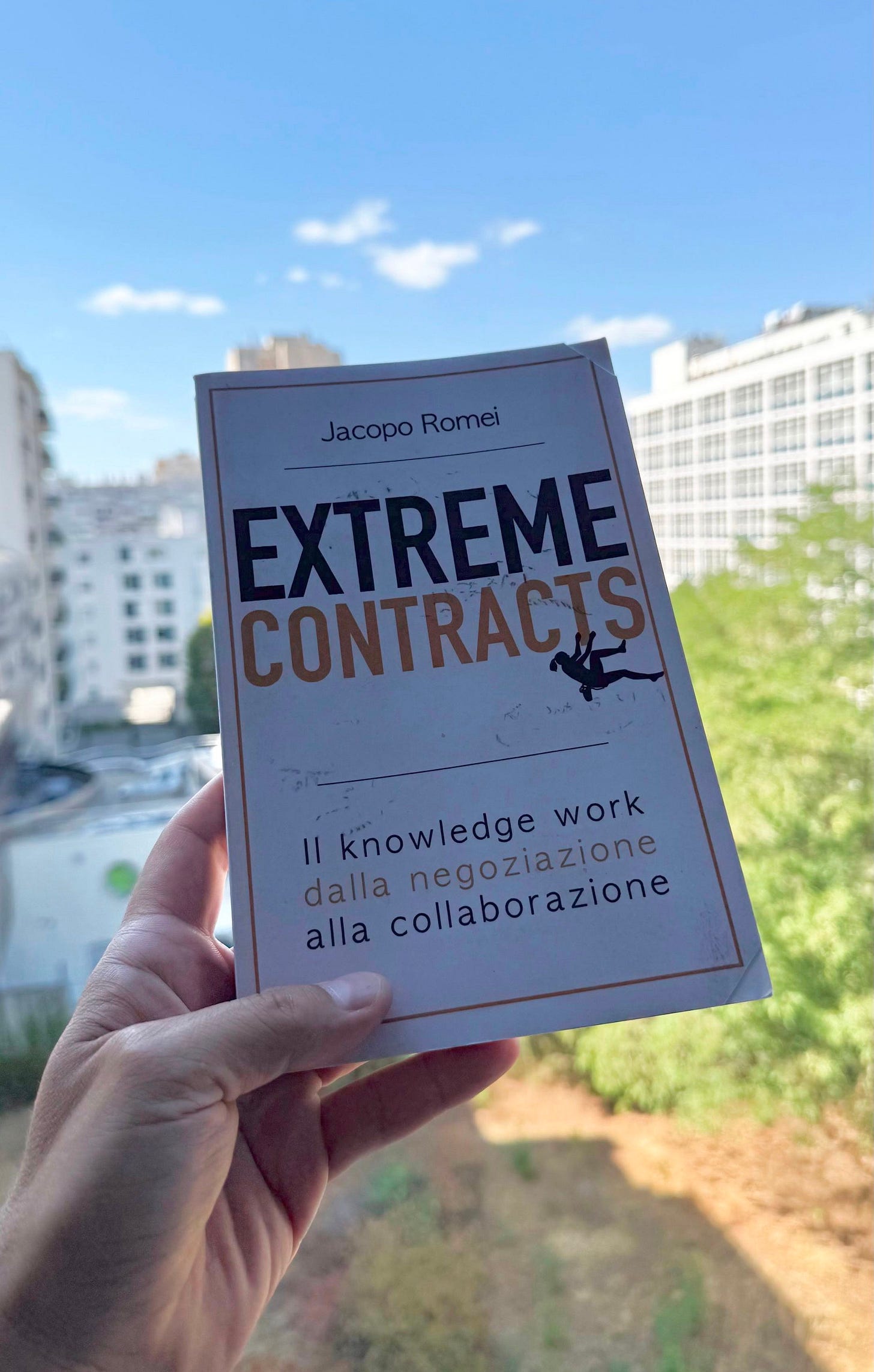
That’s my personal copy of Extreme Contracts in the photo, the very first one, from 2017! You can tell by the scuffed cover and the corner I cut off on purpose: that’s the mark that makes me grab this one off the shelf every time, to scribble notes in, and to avoid ever gifting someone a beat-up copy.
I mention this up front so that nothing I say below sounds like an opinion I hold from a safe distance. I have skin in the game. I bet on this years ago, with the thing I had the most reason to protect, and the bet paid off.
Now the argument.
Nobody made it from scratch
Here’s a question worth sitting with: name one idea of yours that came from nowhere.
You can’t, and neither can I. Every idea I have arrived through something: a book I read, a film that stayed with me, a song, an argument I lost, a mistake I made, a teacher, a rival, my parents, the friends I grew up around, the culture I was soaking in without noticing, a half-remembered conversation on a train. I am, entirely, downstream of my influences, and so are you, and so is every artist you admire.
Jim Jarmusch put the useful version of this bluntly (you probably know him for Stranger Than Paradise, Dead Man, or Coffee and Cigarettes—the deadpan king of American independent cinema). His advice to young filmmakers reads like a manifesto for everything I’m about to argue:
Nothing is original. Steal from anywhere that resonates with inspiration or fuels your imagination. Devour old films, new films, music, books, paintings, photographs, poems, dreams, random conversations, architecture, bridges, street signs, trees, clouds, bodies of water, light and shadows. Select only things to steal from that speak directly to your soul. If you do this, your work (and theft) will be authentic. Authenticity is invaluable; originality is non-existent. And don’t bother concealing your thievery—celebrate it if you feel like it. In any case, always remember what Jean-Luc Godard said: “It’s not where you take things from—it’s where you take them to.”
Authenticity is invaluable; originality is non-existent.
That sentence is easy to nod at and easy to misread, so let me separate the two words carefully, because everything downstream depends on the distinction. Originality, in the pure sense, means made from nothing, with no sources—and that thing simply doesn’t exist, because nobody produces net of their influences. Authenticity means something else entirely: that what you make genuinely reflects your position, your taste, your way of seeing. That’s real, and it’s rare, and here’s the part people miss—it never arrives in perfectly original form, because it always comes downstream of everything you’ve absorbed.
So the thing we’ve spent three centuries trying to protect, originality, is a myth. And the thing that actually carries value, authenticity, was never what the law was protecting in the first place. Which is a good moment to ask how we started protecting the myth at all.
How we learned to fence off ideas
For most of human history, “this is mine” was not a fact of nature. It was a story we agreed to believe.
Here’s the idea, and it’s worth getting right rather than flattening it. There’s objective reality—rivers, trees, a lion—things that exist whether or not anyone believes in them. There’s subjective reality—a headache, a child’s imaginary friend—things that exist in one mind and vanish when that mind stops holding them. And then there’s a third category, the one that does the heavy lifting of civilization: things that are facts only because we collectively agree they are. Money, nations, laws, corporations, property. None of these exist in the physical world. They exist because enough people simultaneously agree to act as if they do—and once that agreement holds across millions of strangers, the fiction becomes as solid and consequential as a mountain. A twenty-euro note is a piece of paper; the shared belief is what makes it buy bread. And these agreements are not permanent truths—if enough people stop believing, the order mutates or disappears, which means every one of them can, in principle, be renegotiated.
Now, plenty of people know this idea from one wildly popular history book published in 2011: Yuval Noah Harari’s Sapiens—the one everybody read, the one that makes its readers feel like intellectuals for having read it. And here’s the thing that matters for exactly the reason this whole newsletter is about: Harari invented none of it. Not even the vocabulary. The concept he built the argument on—intersubjective reality—has a long lineage: the intuition goes back at least to Husserl a century ago, and the argument itself was laid out in full by John Searle in 1995, using the very same example, the banknote. Go further back and Hume was already calling property a social convention in the 1700s; Rousseau’s social contract is the same intuition in a powdered wig. Harari created nothing from scratch. He absorbed a long lineage of thinkers and repackaged it—beautifully, for millions of readers who’d never crack open Searle.
And that is not an insult. It’s the whole point. Harari isn’t original—nobody is—but Sapiens is authentic: his voice, his framing, his selection of what to keep and what to cut. The most-read version of an idea is almost never its first version. Hold onto that, because we’ll need it in a moment.
Property is one of those agreements. Somebody drew a line around a field, everyone else agreed to treat what was inside it as belonging to one person, and a useful convention hardened into something that felt like a law of physics. Useful, yes. Natural, no.
Then, much later, we tried to run the same move on something far stranger than a field: ideas.
Copyright didn’t begin as an author’s natural right. It began as a printers’ privilege. Before 1710, the right to print books in England was controlled by the Stationers’ Company, a guild that held a monopoly on the presses and, with it, the job of censorship. When that monopoly lapsed, Parliament passed the Statute of Anne in 1710—the first copyright law in the world. Read its terms and the origin is unmistakable: “copy” meant the printer’s exclusive right to reproduce a work, protection ran for a mere fourteen years, and the whole apparatus existed to regulate a scarce industrial resource. The point was never to protect the writer’s soul. The point was the printing press—an expensive machine, in a world where copying was hard.
Patents tell a similar story, and one of the most cited examples is also one of the most debated. James Watt held patents on his steam engine, extended by Parliament all the way to 1800. Critics—including economists who’ve made intellectual property their target—argue that those patents held back better steam engines for a generation, because rival improvements couldn’t be built on the protected idea until the monopoly expired; they point to the burst of innovation that followed 1800 as evidence. Other historians push back and call it a myth, attributing the delay to the genuine technical risk of high-pressure steam rather than to the patent itself. I don’t need to settle that fight to make my point. The example is contested precisely because the question it raises is real: what happens to everyone else’s ideas when one idea gets fenced off?
I’ll be careful here, because I don’t want to be misread. I’m not saying creators shouldn’t earn a living—I’ll come back to exactly how they do. I’m saying something narrower and, I think, harder to argue with: a world where ideas circulate freely is better than a world where they’re locked up. The mechanisms we built to reward good ideas by making them un-free were built for a world of scarce copies. That world is over.
The kids who copied Toriyama
Let me make this concrete, because the objection I hear most is that AI “just does collage”—that it stitches finished images together from a drawer of stolen originals.
That’s not how it works, and I’ve known this for thirty years because I watched humans do the real thing back then.
I had friends in high school—Rome, the ‘90s, right in the middle of the manga fever—who copied Dragon Ball obsessively. They redrew Toriyama’s panels over and over, for years, until something clicked. And at the end of all that copying they could draw me—a portrait of Jacopo—in Toriyama’s style. It was a drawing that had never existed before, in a hand that was unmistakably his.
I want to be precise about what did and didn’t happen there, because it’s easy to overstate. Whether a particular style enjoys legal protection is genuinely messy, and it varies—I’m not claiming a clean rule that “style is free and works are protected.” That’s not the interesting part. The interesting part is the mechanism. My friends didn’t photocopy Toriyama and paste him into new arrangements. They internalized how his line worked—the weight, the anatomy, the way an eye is built—and then applied that understanding to subjects Toriyama never drew. The output was new. Derivative in its influences, yes; a copy, no.
That’s the mechanism AI uses. It doesn’t keep a library of finished pictures to collage from. It learns the way a diligent teenager learns by redrawing panels until the style is in the hand, and then it produces things that carry that influence but aren’t lifted from anywhere. The mechanism is old and deeply human. What changed is the scale.
AI just made it enormous
And scale is the whole story. A million teenagers copying Dragon Ball in a Roman classroom wouldn’t have shifted the culture. A model that has internalized a billion influences and can apply them in seconds is the same act, industrialized—the mechanism unchanged, the volume unrecognizable.
So output explodes, and most of it is mediocre. That’s a real cost, and pretending abundance is free would be dishonest. But watch the move the panic makes, because it’s a familiar one. I’ve written before about people who wave away what AI produces by asking whether it “really” thinks—as if a doubt about authentic thought were reason enough to ignore the results sitting right in front of them. Here’s the same move in a new suit: the doubt about “real originality” gets used to delegitimize what AI makes. But originality was never the thing that made human work valuable—nothing is original, remember. So using its absence to dismiss the machine’s output quietly dismisses most human output along with it. We just never said that part out loud.
The real question was never whether a piece of work is original. It’s whether it’s authentic—whether it reflects the position and the taste of the person behind it, even when a machine helped make it.
So how does anyone get paid?
This is the honest objection, and I heard it in the very conversation this newsletter came out of: fine, but how does a person who created real value—who invented a style, say—actually go on living?
The answer isn’t new either. It’s the answer open source has been living for thirty years.
Think about a car for a second. If I buy a Fiat Panda and I want to pull out the carburetor and bolt in one I 3D-printed myself, nobody stops me. Maybe I can’t take it on a public road if it isn’t certified—but on a private track, on my own land, I can do anything I like to that car, because it’s mine. Software, until the ‘90s, didn’t work that way at all. In the Microsoft world, you didn’t own software, you licensed it—a kind of rent. You paid, and still you couldn’t open it, adapt it, or fix it, not even for yourself. It was never really yours.
The open-source community found that absurd, and they turned out to be right in the most consequential way possible: today the vast majority of the web runs on open-source software. The video call this newsletter was born on runs mostly on open-source code, with a thin proprietary layer on top. The people who “gave it all away” didn’t lose. They built the ground the rest of the industry stands on. And they made their living not by charging rent on the code, but on everything the free code made necessary and valuable around it—the consulting, the support, the integration, the expertise.
The same logic runs through my book, and it’s worth spelling out because it’s the crux. If I learn an idea, I’ve already used it—that’s the only thing you can do with an idea, and there’s no version of me, afterward, who un-knows it. The idea is mine the moment it enters my head, and you can’t forbid me from having it. So what exactly would a ban accomplish? It would mean you’re free to spread Extreme Contracts in your own words, but not in mine. And that’s the more harmful option, not the safer one, because the moment you reword an idea to stay on the right side of the law, you risk deforming the idea. I would honestly prefer that you distribute it precisely in the form I authored it. The reproduction was never where the money lived anyway—nobody gets rich printing three hundred pages and handing them out; that costs money. You get paid the way musicians do: the song on the radio is free-ish, and you pay for the live show. The idea travels for nothing, and you pay for the person who can help you do something with it.
Where this leaves us
That’s the whole argument, and it was true long before AI touched it. Nobody creates from nothing. Everyone learns, absorbs, copies, transforms. The point was never to protect originality, because there’s nothing there to protect. The point is to be authentic, and to build something that stands up in a world where the ideas themselves are free to move.
For three centuries we could pretend otherwise, because copies were scarce and the fence around an idea looked like it was doing real work.
AI just tore the fence down and showed us the field was open the whole time.
Jacopo