Stop Asking People What They Want. Watch What They Do.
This article first appeared on Substack at https://jacoporomei.substack.com/p/stop-asking-people-what-they-want.
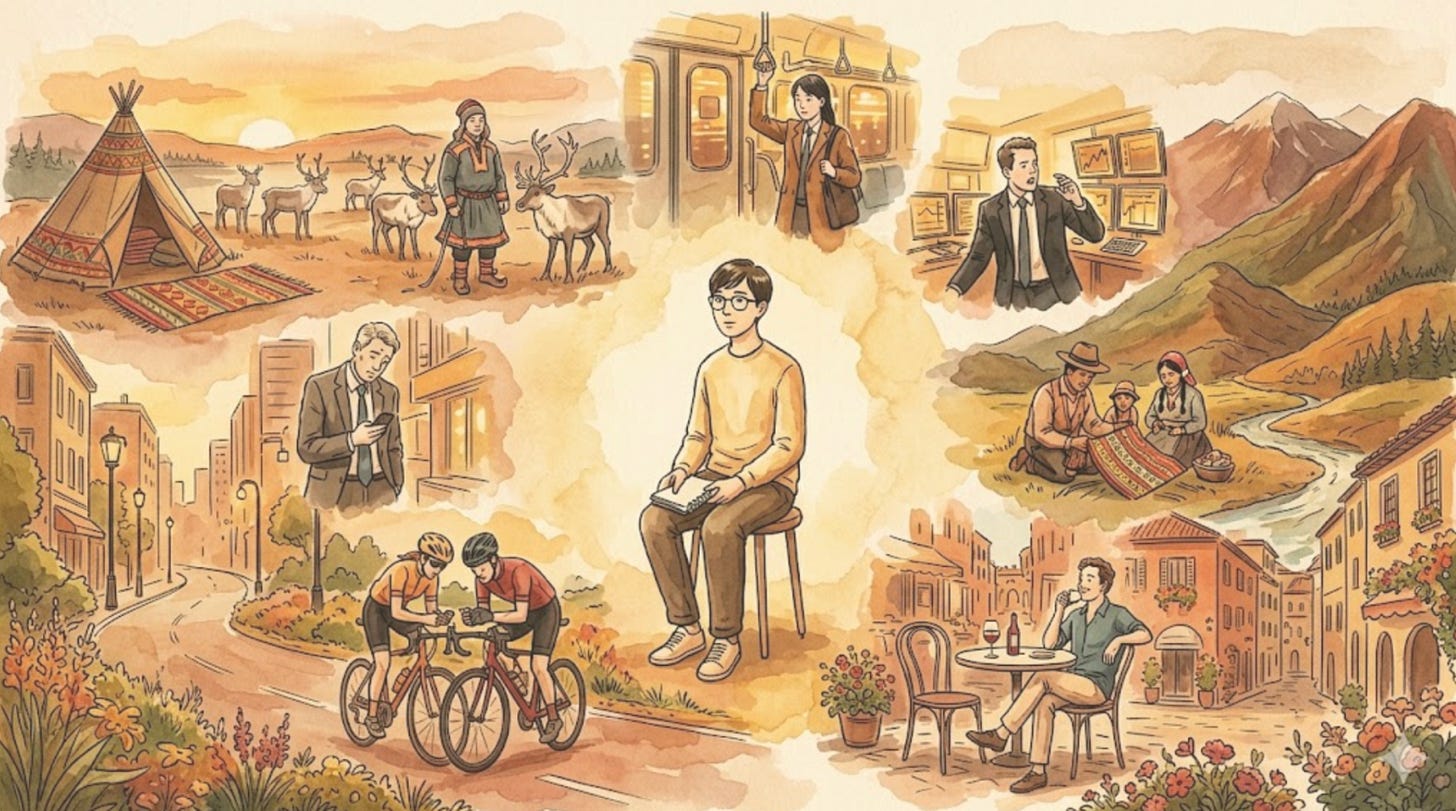
Picture an ethnographer. What do you see?
The stereotypical image that comes to mind is a Eurocentric one: a man in the early 1900s, pith helmet on his head, notebook in hand, sailing off to study some far-flung indigenous people (in the full cliché, painted faces and grass skirts strongly preferred). Now, that picture is already wrong, and not just on the obvious ethical grounds. It’s wrong because ethnography, even in its plainest dictionary definition, is already far more than that.
Ethnography is the serious, anthropological study of living human peoples: how a community actually lives, what it believes, what it does, observed up close and over time.
Living is the operative word—the study of peoples who are gone, through the things they left behind, is archaeology. Ethnography deals with the present. And the present is gloriously varied: you can do ethnography on a farming village in the Andes or on commuters in Tokyo, on Sámi reindeer herders in the north or on the trading floor of a bank in London. Urban and rural, every continent, every environment. The common thread isn’t where people live. It’s that they live a shared kind of life.
Here’s the part that does the real work, though. Nothing in that definition says the human group whose customs you study has to be a “people” in the sense of a nation or an ethnicity. It can just as easily be a group of people. A community held together not by blood or borders, but by a shared way of living.
The Sámi are a community. But so are road cyclists who track every ride, new parents drowning in conflicting advice, and executives who know they should be visible online and have no energy left to do anything about it. These are tribes too. They have rituals, shared frustrations, unwritten rules, and behaviors that no demographic table will ever show you.
Which is what makes the business application of the discipline so much more useful than the postcard version. It’s the same method, pointed at a different field. In a business context, an ethnographer doesn’t immerse themselves in a tribe across the world. They immerse themselves in your users.
They watch how people actually use a product or a service, in the real place where they use it, to surface the needs and motivations those people would never put into a survey.
What people say, and what people do
This is where it stops being academic stuff—intellectual navel-gazing—and starts paying rent.
What people say they do and what they actually do are rarely the same thing. They don’t fully know themselves; they tidy up the story after the fact, and the version of themselves they hand you in an interview is often the version they’d prefer were true. Ask someone how they pick a book, and you’ll get a clean, sensible answer. Follow them into the shop, and you’ll see something messier, and far more useful.
This is the line that gets blurred constantly, so let me draw it sharply: purchasing habits are not ethnography.
Purchasing habits are statistics. Demographics. “Forty-seven percent of men between thirty-five and forty-five buy thirty-six percent of the magazines.” That data tells you who and how many. It will never tell you why, and it will never tell you how. It’s a photograph of a crowd taken from across the street.
Ethnography follows one of those shoppers into the store and watches what they do. Do they wander, or walk straight to a section? Do they flip the book over, read the back, riffle the pages? Do they ask the clerk a question, or would they rather die than ask? Do they photograph the cover to buy it cheaper online on the way home?
Years ago I did exactly this. We had a startup idea: we wanted to see whether you could bring a layer of gamification into the experience of buying books—so we went and watched people do it, in a big bookshop, in the place where they were actually choosing. We weren’t running anyone’s checkout. We were watching, to find out if a need was even there. Twenty minutes of that gives you things a quarter’s worth of sales data won’t, because the sales figures only record the ending—bought, or not bought—and never the small, telling story that led there.
And ethnography also shows you where the value isn’t. Build on what people say, and you build for a customer who doesn’t exist. You spend the energy and the budget building a product on a stated need nobody actually acts on.
“But twenty people aren’t significant!”
Here’s the conversation I have every time.
I tell someone to go watch their users, an hour each, in the wild. They look at me like I’ve lost it: “An hour each? How am I supposed to do that for three thousand people?” And I say: “Why three thousand? Watch twenty”. And there it comes, glasses pushed up the nose, the Dwight Schrute of the meeting: “Yeah, but twenty people aren’t a statistically significant sample!”
They’d say it even if I told them that nineteen of those twenty had bought the book, hugged it to their chest, and read the first chapter standing in the aisle before they’d reached the till. A reaction that, personally, would tell me something.
One hour with twenty or thirty carefully chosen people gives you what no funnel ever will: depth. Their context, the texture of an ordinary day, the moods behind the choice—and, best of all, the insights that arrive sideways, the corner of the need you didn’t even know to look for.
I like to put the concept of depth this way: think of the best gift you ever gave someone close to you—a sibling, a parent. You nailed it. Were you working from a statistically significant sample of siblings? Of course not. Nobody has one. You nailed it because you know that person, and the gift fits their life. Knowing someone well correlates with getting it right; it isn’t caused by sample size. The same holds for the people you build for. And if fifteen out of thirty describe the same need, which is more likely: that you stumbled, by sheer bad luck, onto the only fifteen people on earth with that problem? Or that the need is genuinely common, even if your 50% isn’t a precise mirror of the real-world percentage? If it really were dumb luck fifteen times over, fine—I’ll grant the statistician their point and run the numbers later. Just very bad luck. 🤷
In everyday life, we get there intuitively. Imagine you’re at an event with a hundred potential clients. How do you spend your time? Do you hand each of them a form with two standardized questions, or do you find the ten who seem most receptive and give each one twenty real minutes of conversation? One approach counts people. The other understands them.
The easiest ethnography is the one you don’t have to do
The hardest way to do ethnography is from the outside: entering a tribe you don’t belong to, learning its language, earning enough trust to see past the performance. It works, but it’s slow and expensive.
The easiest way is to already be one of them.
When you build for a need you live yourself, the ethnography is done before you start. Not skipped—done. Because you’re inside the group, and by the ordinary logic of how people cluster, you’re surrounded by others like you. You meet them, you talk to them, you hear the same complaint at dinner that you feel at your own desk. You don’t have to schedule the field study; the field is your life. The right questions come naturally because you’ve already asked them of yourself. And you can test a first version of the solution on the most available subject there is: you.
One honest caveat, before the statistician comes back for round two. Being your own user is a superpower for discovery—it tells you, fast and for free, that a real need exists and roughly what shape it has. It does not do your validation for you. That a problem is real for you, and that your solution works for you, is not yet proof that a market will pay for it. Discovery is “the need exists.” Validation is “enough of the right people will act on it.” Living inside the problem hands you the first for nothing. The second you still have to earn.
Strava is the obvious example: it wasn’t born from someone observing cyclists through glass. Its founders were former Harvard rowers who missed the camaraderie of the boathouse and the pull of a shared leaderboard, and built the thing for the tribe they already belonged to. They didn’t survey the market. They were the market.
But let me give you one of my own. Back in 2002 I was building something for a hotel-booking job, and I went looking for an open-source platform in the language I was working in. There wasn’t one. So I said: fine, I’ll build it myself. I called it phpMyHotels. I made it because I needed it—that’s the discovery, done for free, by being my own user. What happened next is the part that isn’t free: people I’d never met started sending donations: $500 landing in my inbox from some American telling me to keep going, years before crowdfunding was a thing. That was the market validating the thing. I went on to build my second company on top of it. The need, I’d found by looking in the mirror. Whether anyone else would pay—that, the world had to tell me.
Another example: Scaling Tales—the company I run with —exists for the same reason. We didn’t observe a niche from a distance. We were in it. My own problem was wanting to keep a consistent, high-quality presence on social, and doing it in fits and starts, because I rarely had the uninterrupted time to sit down at the Mac and actually write. I watched that same behavior repeat itself among the executives, founders, and high-ticket freelancers I kept meeting, and I recognized it instantly, because it was mine too: people who understand perfectly well that they should be managing a personal brand, who don’t need convincing, and who have nothing left in the tank to actually do it. The truest version of the need isn’t “get me more followers.” It’s closer to: I find writing my own content draining, and I have to do it anyway.
A survey would have returned “wants more visibility.” Useless. What we saw—partly because we felt it ourselves—was a need for delegation that had to be three things at once: efficient, costing almost no time or energy; reliable, with no slip-ups you’d have to keep double-checking for; and proactive, able to read the need before it’s been put into words. No questionnaire surfaces that. We knew it the way you know your own problem, and then we checked it was real on the one person we had unlimited access to—me—before working out exactly which tribe would feel it most, and how.
So, before you build
If you’re about to launch something and you feel the urge to ask your customers what they want, pause. They’ll answer, sincerely, and they’ll describe the customer they believe themselves to be, not the one who shows up on a Tuesday with a real problem and real money.
The best businesses tend to be built by people who needed them first, because they come with the ethnography already done. But if you’re not building for your own tribe, you don’t get to skip the work. You go do it. Sit in the shop. Watch the twenty. Find the need people are living out but can’t articulate.
Your customers won’t tell you the truth. Not because they’re lying, but because they don’t know it. They’ll show you, every single day, if you bother to watch.
— Jacopo