Dead People Vote
This article first appeared on Substack at https://jacoporomei.substack.com/p/youre-still-paying-for-decisions.
There’s a small plastic bin that lives on hotel breakfast tables. I’d walked past plenty of them myself, for years, without ever stopping to notice.
Then one morning I did, and once I started noticing, I couldn’t stop.
One-star hotels, five-star hotels, hotels in cities and hotels in the mountains. Sustainable hotels where individual jam packets and butter foils don’t exist anymore, replaced by glass jars filled fresh in the morning, refillable honey pots, and bulk yogurt in ceramic bowls. The bin shows up across all of these categories. Sometimes it’s plastic, sometimes ceramic, sometimes a small stainless-steel cylinder. The form changes, but the function—or rather, the missing function—stays the same.
Most of the time it sits there empty. Very few people seem to use it, and nobody seems to ask why it’s there.
So I started asking myself why.
The whale in the room
The question pointed me, oddly enough, toward biology.
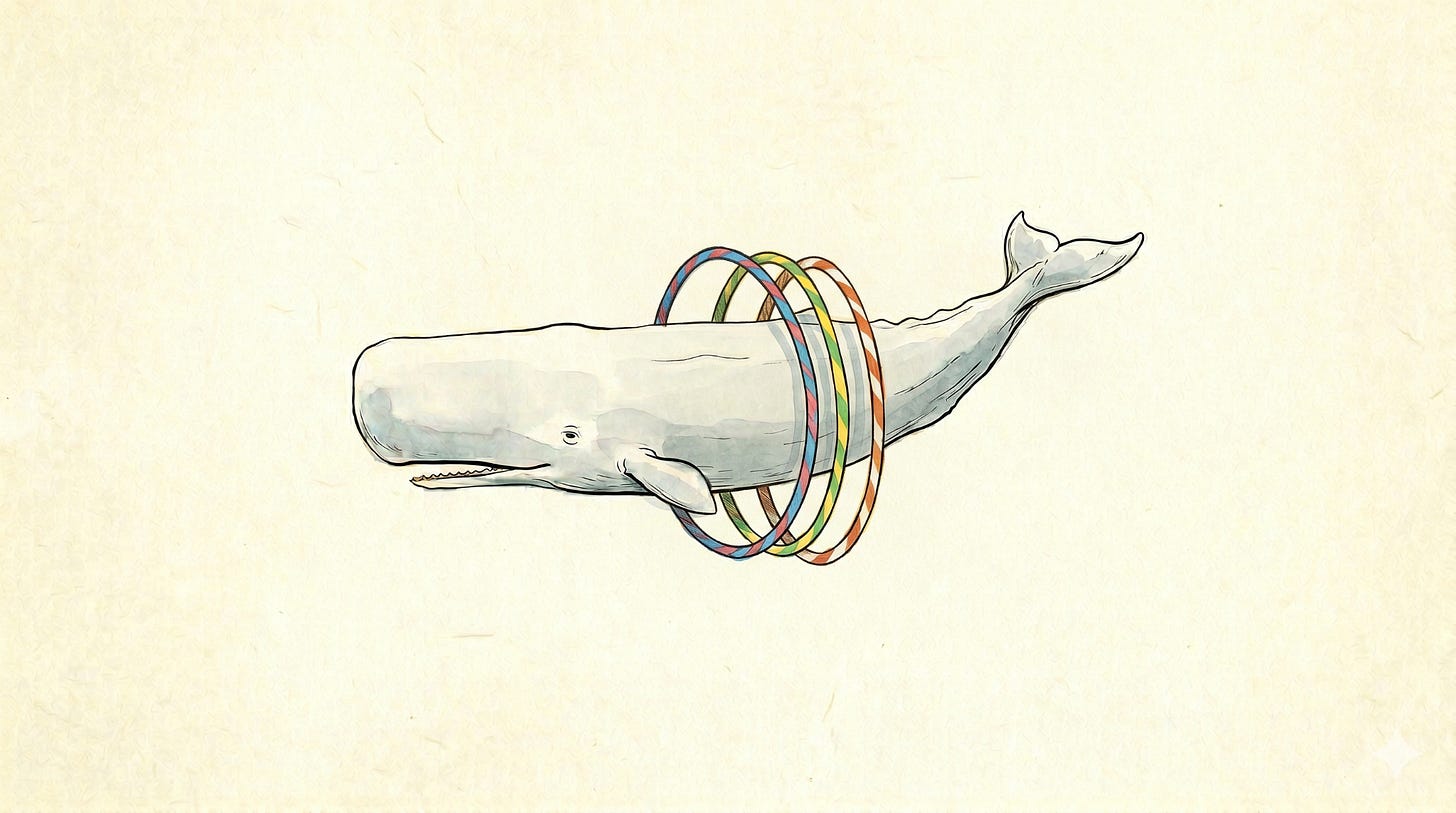
Whales have hip bones.
An animal twenty to thirty meters long, with no legs and no pelvis to support, and yet, tucked deep inside its body, there are two small bones, roughly the length of a human hand, in the place where a pelvis used to be.
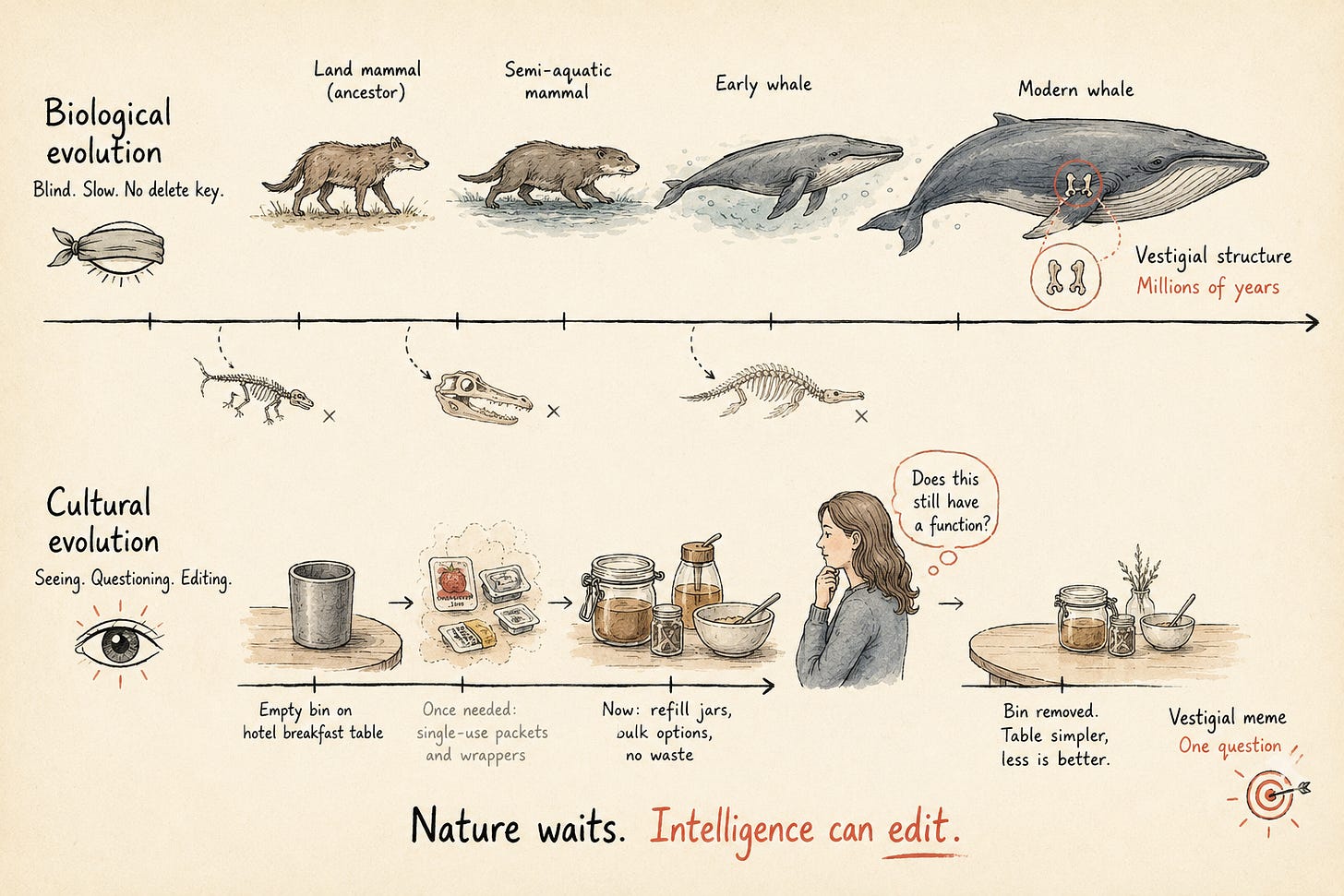
The whales we see today are descendants of land mammals whose distant ancestors walked. About fifty million years ago, those ancestors returned to the sea, and over millions of generations natural selection favored bodies progressively better suited to swimming: limbs that flattened into flippers, nostrils that shifted toward the top of the head, spines that bent vertically rather than horizontally. The pelvis couldn’t disappear from one generation to the next—evolution doesn’t work that way—but generation after generation, individuals with smaller pelvic bones were marginally favored, and after enough time what’s left is two small bones inside a body that size.
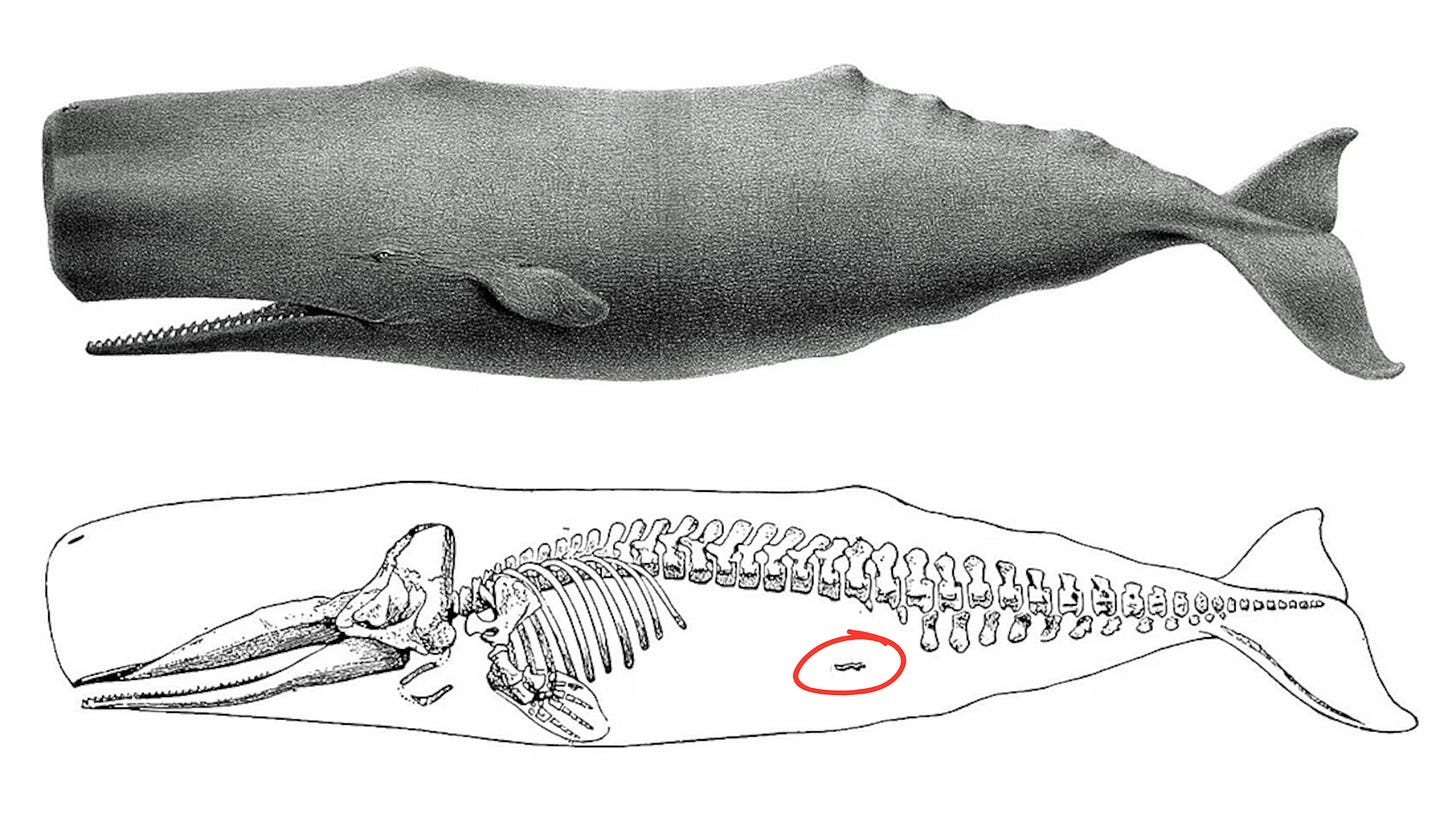
Biologists call them vestigial structures: anatomical features that have lost their original function during evolution but haven’t fully disappeared. Whale hips. The human appendix. The plica semilunaris in the inner corner of your eye, a residue of the third eyelid that reptiles and cats still have. The wisdom teeth your dentist removed at twenty-two.
These structures stick around for a precise reason. Natural evolution has no delete key: it works by selection, filtering out features that actively harm survival or reproduction across generations, while features that have simply stopped being useful—but don’t actively hurt—tend to persist. There is no biological mechanism to quickly remove what no longer earns its keep: nothing actively pushes against the neutral, so the neutral gets carried along from one generation to the next.
The bin on the breakfast table works the same way. It’s a vestigial structure—just not a biological one.
Cultural “whale hips”
In 1976, Richard Dawkins published The Selfish Gene. In the final chapter, almost as an afterthought, he proposed a new term—long before the internet borrowed it for something narrower: meme.
A meme, for Dawkins, was a unit of cultural replication: ideas, habits, rituals, melodies, recipes, objects—anything that propagates from mind to mind the way genes propagate from body to body. A meme spreads by being copied and survives because it keeps getting re-copied. And like a gene, a meme is indifferent to the welfare of its host. A useful meme gets copied. A meme that’s actively harmful but easy to copy also gets copied. And a meme that has stopped being useful, yet is still easy to copy and doesn’t visibly hurt anyone, also keeps getting copied.
That last category is the cultural equivalent of a whale’s hip.
The bin on the breakfast table is one of those. Nobody decided this morning that the bin should be there. Somewhere, decades ago—back when individual jam packets, butter foils, single-serving honey containers and disposable creamers were the standard—the bin solved a real problem: guests needed somewhere to put the wrappers, and the bin was the answer. The answer got copied, from hotel to hotel, supplier to supplier, training manual to training manual, fitting-out catalog to fitting-out catalog. The meme spread.
Then the world changed. Sustainability concerns made individual packaging unfashionable, and the original problem—where do guests put the wrappers?—disappeared. The bin didn’t. Nobody copied the bin into the new world on purpose: it just kept getting re-copied, by default, because removing it would have required someone, somewhere, to actively notice it and decide it could go. Nobody did.
A vestigial meme. A cultural whale hip.
Why dead choices keep getting re-ratified
The deeper question is why we let this happen at all.
There’s a line that floats around the internet: tradition is peer pressure from dead people.
It’s a glib formulation that hides a serious point. Most of the choices that shape our daily environment were made by people we never met, in conditions we no longer share, and yet those choices keep producing effects, because nobody alive ever bothers to revisit them. The hotel manager stocking those bins this morning didn’t choose them—they inherited them, and their predecessors inherited them too. Somewhere far back in time, someone made an actual decision, and that decision has been silently re-ratified every morning since, by nobody in particular.
The dead are voting. The living are nodding along.
This is how vestigial memes survive—not because anyone is defending them, but because nobody alive is paid, asked, or curious enough to challenge them.
The tool we have, and don’t use
Here’s where it gets interesting.
Biological evolution is blind: it has no teleology—a word from the Greek telos, meaning “end” or “purpose,” combined with logos, meaning “reasoning,” “rational discourse,” or “study of.” A teleological process is one oriented toward a goal, and evolution simply isn’t. It doesn’t plan, anticipate, or look at a whale and decide that the hip bones should go; it just produces variation across generations, and the variants that fail to reproduce well enough fade out over time. Across enough time this looks like progress, but it isn’t progress in any directed sense—it’s just a long, indifferent process of sieving.
(Side note: the philosopher Günther Anders, husband of Hannah Arendt, spent much of his work showing that our instinctive sense of progress as a single direction is essentially a secular rewriting of Christian teleology, smuggled into modern thought through the back door. Evolution doesn’t share that picture at all. Sometimes it produces more complexity, sometimes less. Viruses and parasites are textbook cases of organisms that evolved by shedding capabilities rather than adding them. Both are evolutionary success stories. Both are really simple.)
Across the history of life on Earth, billions upon billions of organisms appeared, failed to reproduce well enough, and disappeared. Entire species—millions of them—have gone extinct along the way. Evolution pays for every step of what looks like progress with an enormous mass of casualties.
Human intelligence is something else entirely.
For the first time on Earth, there’s a tool that can see ahead. We don’t need to wait a million years for a useless bone to fade away through random variation—we can look at a thing, understand that it has lost its function, and remove it. In one morning, the bin disappears. In one quarter, a redundant process gets dismantled. In one generation, a norm built for a world that no longer exists can be retired. When we choose to be conscious about it, cultural evolution doesn’t have to follow biological pace at all.
This is, quite literally, a superpower. The whales’ skeletons can’t do it. Nothing else on the planet can do it with such a long-term perspective. We are the first species capable of looking at our own vestigial structures—biological, cultural, organizational—and asking the one question evolution never can: does this still do anything?
The question doesn’t always end in deletion—and out in nature, a vestigial structure doesn’t always stay idle either. Sometimes, given enough time, it gets put back to work.
For more than a century, those whale hip bones were the textbook case of a useless leftover—copied from biology book to biology book as the perfect example of a structure that does nothing. Then, in 2014, someone actually checked. And here’s the irony: the example everyone trusted most—the textbook vestigial bones, the ones I leaned on earlier—was the wrong example. A team of biologists found the bones are still under active selection: they’re larger in more promiscuous species, their shape tracks the mating system, and they anchor the muscles that control the male’s genitals. The bones everyone filed under ‘leftovers’ turned out to be doing a job the whole time—we just hadn’t measured it.
That’s the whole point. Sometimes the answer is no, and the thing goes: the bin leaves the breakfast table. Sometimes the answer is yes, and you’ve found a function hiding in plain sight. Either way, you only find out because you asked. The bin and the whale are the same move with opposite results.
And maybe—who knows—one day you ask it about the bin itself, and the answer is yes: somewhere there’s still someone who likes tossing a crumpled napkin in there. Fine. You found out because you asked.
We have the privilege of bypassing blind evolution—pruning what’s dead, recognizing what’s secretly alive. We rarely use it.
Vestigial memes are everywhere, once you start looking
Once the framework is in your head, you stop being able to unsee them. A few that come up often:
The time clock for remote workers. The tool was invented in the late nineteenth century to measure physical presence on a factory floor, and the reasoning was sound at the time: industrial work meant standing at a machine, and the simplest way to know whether work was being done was to know whether the worker was there. Today, much of office work is fully remote and fully cognitive, and hours logged on a laptop are not value produced—they are, at best, a proxy, and a bad one. The original problem the time clock was solving doesn’t exist for most knowledge workers anymore, but the meme survives anyway: companies still pay good money for software that tracks logged-in time, generates reports, and turns presence into a metric.
Pay grades before output. The labels ‘junior, mid-level, senior’ decide compensation before anyone looks at what the person actually delivers. This was a reasonable meme in the Taylorist era, when output really was measurable in units of time at a workbench and seniority correlated tightly with productivity. We don’t work that way anymore. A designer with three years of experience who has integrated AI into their workflow with care—using generative tools for early exploration, custom prompts for refinement, AI-assisted research at the start of every project—can ship more useful work in a quarter than a designer with fifteen years of purely manual experience. The inverse is sometimes true too. The point is that experience-time and value-output have come apart, and the pay grade pretends they haven’t: the grade decides first, and the output is fitted to it afterwards. We act as though the relation runs the other way. It doesn’t.
The ‘career objectives’ section on a CV. A document born in an age of linear careers, where the path went engineer, senior engineer, manager, VP, but maintained in an age where the job someone will hold in ten years probably doesn’t exist yet, and where most people’s actual trajectories look more like zigzags than ladders. Almost nobody writes career objectives that survive contact with reality, and almost everybody keeps writing them anyway, because the template demands the field.
And many more—across companies, institutions, daily rituals, conversational habits. Each of these costs money, time, or attention, and none of them has been seriously interrogated in a long time.
A necessary note about the bin itself. It’s not a big problem. It won’t bankrupt the hotel, it won’t ruin anyone’s breakfast, and most guests have probably never noticed it enough to complain. Someone, here and there, may even use it occasionally—a stray sugar wrapper, a torn croissant flake. The point isn’t that the bin never serves anyone. The point is that nothing in the room would change if it weren’t there. That’s precisely why it’s the perfect training ground. When a vestigial meme is small, neutral, harmless, there’s no urgency, no pressure, no crisis forcing us to look—which is exactly the condition in which we can practice looking, calmly, without anything at stake. The same kind of seeing pays off on bigger memes: the processes that cost millions, the roles that block entire departments, the norms that age a company by a decade. If we can’t notice the bin on the breakfast table, we won’t notice the rest.
What the question costs
Every time you hear “we’ve always done it this way,” you’re looking at a vestigial meme. You don’t have to demolish it, and you don’t have to fight anyone over it: you just have to ask one question—does this still have a function?
That single question is the entire point. It’s free, it takes a few seconds, and it’s the one question that only a thinking species can ask. Other animals propagate behaviors across generations—Japanese macaques famously teach each other to wash sweet potatoes in seawater, and the practice spreads through the troop and survives the original innovator—but transmitting a habit is not the same as interrogating it. No other animal on Earth, as far as we know, can stop, look at a piece of its environment, its body, or its culture, and wonder whether the piece still makes sense.
And yet we still behave like whales.
The real waste isn’t the bin on the breakfast table, but the faculty of seeing we don’t use.
Thanks for reading Jacopo Romei // The Sweep! Subscribe for free to receive new posts! 🧹