The UX of Being a Citizen Is Broken
This article first appeared on Substack at https://jacoporomei.substack.com/p/the-ux-of-being-a-citizen-is-broken.
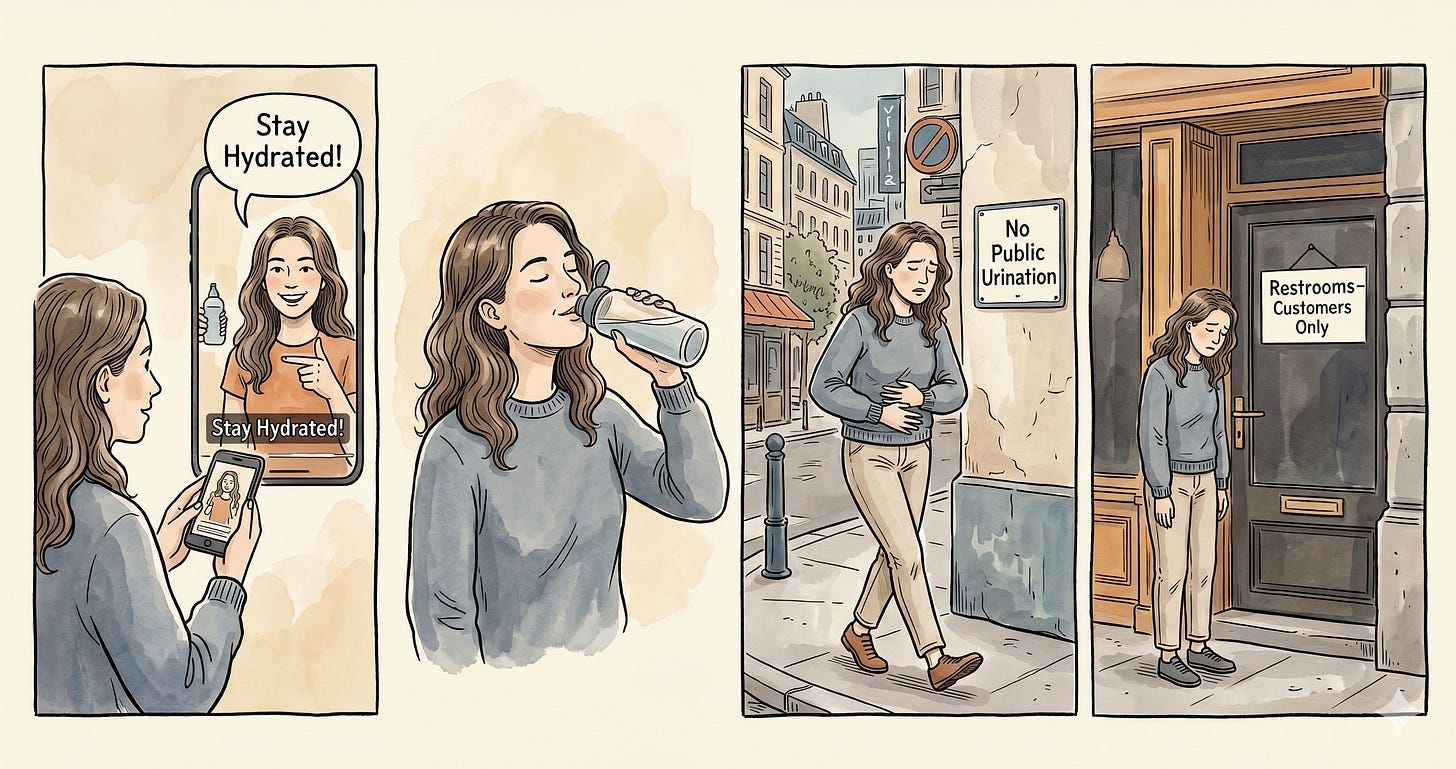
What follows might make you laugh in a few places, but I’m pretty serious about it. 😅
There are three conditions in our society that, taken together, make no sense. The first is biological: peeing is a non-negotiable need, on the same tier as eating and drinking. The second is a recommendation you hear everywhere—from doctors, health articles, wellness influencers: drink a lot of water, stay hydrated, at least two liters a day. The third is structural: in most cities I’ve lived in or traveled to, free public restrooms either don’t exist or are remarkably hard to find—and when you need one, you don’t exactly have time to find an app or study a map. Meanwhile, peeing in the street is illegal or punishable in many places.
The very same society that encourages hydration often fails to provide a practical way to deal with its natural consequence. I must drink, and if I drink, I must pee every couple of hours—but there’s nowhere to do it without paying, and if I do it outside, I’m breaking the law.
I realized how absurd this was one day while walking a friend’s dog. He stopped, peed in a flower bed, and moved on. No line, no fee, no sign reading “restroom for paying customers only.” The dog, at that moment, had more freedom than I did. To be clear: I’m not advocating for peeing in the street—for the record, I’m personally uncomfortable peeing even in public restrooms—but the contrast is hard to ignore.
What makes this interesting to me isn’t the bathroom itself. It’s the fact that as a citizen, I’m a user of a system—institutions, rules, public spaces, infrastructure—and that system, in many cases, simply wasn’t designed with my experience in mind. The restroom situation is a vivid example, but it’s far from the only one. We’ve built a society that, in many everyday situations, doesn’t work in the interest of its own citizens—which is a paradox, because that’s what society is supposed to exist for, based on each of its members’ contributions.
The same pattern, everywhere
I don’t want to paint a dystopian picture—most of the time, things work well enough. But “well enough” hides some surprising friction.
Consider what happens when you buy a house in many markets. It’s one of the largest financial decisions a person will ever make, and yet the process often leaves the buyer exposed in practice. Disclosure rules vary by jurisdiction, but the incentives in the process often don’t align with the buyer’s interests—and the burden of due diligence ends up on the buyer. You can ask directly, “Is there anything wrong with this house?” and receive a reassuring answer that omits information you wish you had. You discover the leaking roof, the faulty wiring, or the mold problem after you’ve signed and paid. Too late—and even when remedies exist, they can be slow, costly, and hard to enforce. There are startups trying to change this—transparent documentation, open inspections, buyer-side protections built into the process—but the default experience, the one most people go through, often favors the seller.
Or consider a more everyday example: paying with a card. Over the past decade, society has been pushing hard toward digital payments. Fewer ATMs, contactless terminals everywhere, banks closing physical branches, tax incentives for electronic transactions. The message from institutions and financial systems alike is clear: stop using cash, go digital. But then you walk into a bar or a small shop and find a handwritten sign: “No card payments under €10.” In some European countries—Italy, for instance—this is illegal: since 2022, merchants are required to accept electronic payments for any amount. In others—Germany, notably—refusing card payments is perfectly within the merchant’s rights, regardless of the amount. Either way, the experience for the customer is the same friction: before you can even think about what you need to buy, you first have to negotiate the terms of the transaction. “Do you take card?” “Up to what amount?” “Is there an ATM nearby?” The system pushed you to abandon cash, and now punishes you for having done so.
Or take public transport. In Turin—a city I know well—I’ve often found that the problem isn’t just that buses run late, which would be one level of inconvenience you could at least plan around. The deeper problem is that the information about when buses will arrive is itself unreliable. Google Maps tells you a bus will be at your stop in three minutes; you wait, and the bus never comes, because the real-time data wasn’t updated to reflect that the route had been changed or the bus cancelled. So you can’t plan according to the schedule, because the schedule doesn’t match reality, and you can’t adjust in real time, because the real-time information doesn’t match reality either. Meanwhile, the same city tells its citizens to use public transport to reduce emissions—a perfectly reasonable request that becomes almost impossible to follow when the experience of using public transport requires, quite literally, an act of faith. Fewer people ride the bus, which means less revenue for the transit authority, which means worse service, which means even fewer riders. A vicious cycle that began with an experience nobody bothered to get right.
All of these situations—the restroom, the house, the payment, the bus—share the same structural flaw: the system was designed from the inside out, from the perspective of whoever built it, instead of from the outside in, from the perspective of whoever has to use it.
The curse
I came to this way of thinking around 2008, when I was deep into agile software development—writing clean code, running automated tests, refactoring constantly. Around that time, I met several UX professionals who shifted my perspective entirely. Their influence made me realize that the quality I perceived as a developer mattered far less than the quality perceived by the person actually using what I’d built. For me, it was a small Copernican revolution: the center of gravity moved from the producer to the user.
Eighteen years later, I haven’t been able to turn it off.
UX is not a department, not a job title, not a line item on a product roadmap. It’s a lens through which you look at the world—and once you start using it, you use it on everything. It’s a kind of curse, honestly. You start noticing that most systems—companies, institutions, public spaces, civic processes—were designed without ever seriously asking: what will this actually feel like for the person on the other end? And you start noticing that most people simply endure the friction. They accept the line, the delay, the workaround, the missing restroom, the unreliable bus—not because they’re fine with it, but because they’ve stopped seeing it.
But noticing is only the first step. What I’ve found more interesting, over the years, is understanding why these failures persist—because it’s rarely ignorance. The people who designed these systems aren’t stupid. They often have data, budgets, and good intentions. And yet the experience still fails.
In my work as a consultant, I’ve come to recognize a pattern. When a user experience breaks down—whether it’s a civic service, a product, or an internal company process—the people responsible almost always react in one of three ways. The easiest way I’ve found to explain the difference is with a coin.
The coin
Imagine you are playing heads or tails with some friends. You flip a coin 99 times, and every single time it lands on heads. What comes up on the hundredth flip?
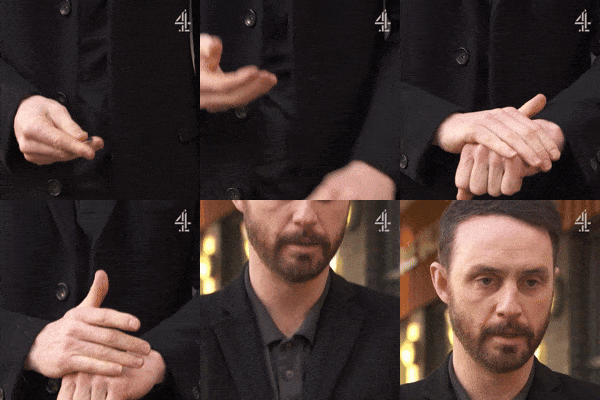
Most of you can recognize that the first reaction is emotional, almost magical: “It has to be tails—it’s overdue!” This is the gambler’s fallacy, the idea that past outcomes somehow influence future ones in a random process. Sure, we know they don’t and we do our homework: each flip is independent, and the fact that heads came up 99 times has no mathematical bearing on flip number 100.
This leads to the second rationalist reaction: “It’s still 50/50—each flip is independent, the probability doesn’t change,” which is technically correct. If you’re working within a model where the coin is fair, the math holds perfectly. But notice what this answer does: it blindly trusts the model and dismisses the evidence. Ninety-nine heads in a row, and the response is “the model says it’s going to be 50/50.”
There is a third way.
We can be more pragmatic: “If a coin has landed on heads 99 times in a row, it’s probably not a fair coin. I’m betting on heads.” This answer doesn’t reject statistical theory. It just steps outside the model, looks at the accumulated evidence, and concludes that the model itself needs updating. Instead of asking “what does the model predict?”, it asks “is the model still valid?”
The difference between the second and third reactions is the difference between trusting your theory and trusting your evidence. And it’s exactly the distinction that separates people who maintain broken experiences from people who fix them.
The line in front of the women’s restroom
Now let me bring this back to restrooms—because it turns out they illustrate all three reactions perfectly, and from an angle you might not expect.
You’ve seen this a thousand times. You’re at an airport, an office building, a concert venue, or a conference center. The restrooms are designed symmetrically: roughly equal space for men and women. There’s a long line in front of the women’s restroom, and no line at all in front of the men’s.
The emotional reaction: “Women are slow—that’s how it is.“ It attributes the problem to the users, frames it as inevitable, and moves on. It doesn’t ask why.
The rationalist reaction: “We allocated the same amount of space to both. The distribution is fair. 50/50.” It trusts the model—equal allocation equals equal treatment—and ignores the evidence staring at it from the hallway. The allocation is correct on paper, the experience is broken in reality, and the response is: “the model says it’s fine.”
The pragmatic reaction: “There’s always a line in front of the women’s restroom. Always. Everywhere. Decade after decade. Something about the model is wrong—let’s look at the evidence and figure out what.”
And when you look, the reasons are biological, logistical, and structural—not behavioral. On the demand side, as Caroline Criado Perez documents in Invisible Women, women take up to 2.3 times longer than men per bathroom visit. Add menstruation (more time per visit), pregnancy (reduced bladder capacity), and urinary tract infections (which women suffer eight times more often than men), and demand goes up further. And the caregiving logistics—accompanying children, the elderly, the disabled—still, absurdly, rarely fall on the men’s side.
On the supply side, building codes have historically formalized a 50/50 split of floor space between men’s and women’s restrooms. But a men’s room can combine urinals and stalls in the same footprint, while a women’s room can only have stalls. Urinals take less space, so the men’s side processes more people per minute through the same area. “Equal” floor space turns out to mean unequal capacity.
But here’s the deeper point: even if none of these structural reasons existed—even if the disparity had no known explanation at all—what should you do? Ignore the evidence and fall back on a model? On a prejudice? On a judgment about who’s “too slow”? The people using those restrooms are users with needs. When the same pattern shows up again and again, across countries, airports, venues, and decades, you don’t explain it away. You observe it, you respect it, and you act on it.
The fix is obvious once you accept the evidence instead of defending the model.
I know a coworking space in Milan that allocated two restrooms for women and one for men. The line disappeared from both sides. Simple as that. That’s what happens when you update the model to match reality instead of insisting that reality should match the model.
The approach we want to avoid is the one captured by the old medical joke: the operation was successful, but the patient died. You can design a system that is perfectly correct on paper—50/50, fair allocation, balanced resources—and still produce an experience that fails half your users. If your model says everything should work and reality says it doesn’t, the problem is not reality. It’s the model.
So: where is your line?
This is where it stops being about restrooms and starts being about you.
Think about your own work—your product, your service, your team, your internal process. Where are you doing 50/50, convinced it’s fair, while the evidence tells you otherwise? Where are you trusting the model—”our onboarding process is solid”, “our clients are satisfied”, “our workflow is efficient”—without checking whether the experience on the other end matches the proclamation?
When a customer churns and you say “they weren’t the right fit”, is that the evidence talking, or is that the model defending itself? When your team keeps missing deadlines and you say “we need better planning”, have you checked whether the problem is really planning, or whether it’s something upstream that your process doesn’t account for? When you say “our product does everything the client asked for” and the client still isn’t happy, is the operation successful, or is the patient dead?
The emotional reaction is to blame the users: they’re too slow, too demanding, too disorganized. The rationalist reaction is to trust the model: we did everything right, the process is correct, the allocation is fair. The pragmatic reaction is to look at the line forming in the hallway and say: something here isn’t working the way we think it is. Let’s find out what.
UX, in the end, isn’t a skill you apply to screens. It’s a discipline of looking at reality instead of trusting your assumptions about reality. And the question is always the same, whether you’re asking if a city has enough public restrooms, whether a product has the features that actually matter to its users, or whether a service truly improves a client’s life without adding new burdens in the process: who is this for, and does their experience match what I think it is?
If we all did this—looked at reality instead of defending our models—we could build better businesses, better products, better services. But also better cities, better institutions, and communities where more people feel like the system was actually designed for them.
Best,
Jacopo
Thanks for reading Jacopo Romei // The Sweep! Subscribe for free to receive new posts and support my work.