What Spotify did to music, AI will do to everything.
This article first appeared on Substack at https://jacoporomei.substack.com/p/what-spotify-did-to-music-ai-will.
In this newsletter, I’ll make a few points:
-
When a market opens up, low quality gets added to high quality. It does not replace it.
-
The two most common complaints about market democratization (“anyone can do it now” and “nobody earns enough”) are not contradictory. They are the same phenomenon.
-
Many critics miss that the old system would never have included them either.
-
Two cognitive biases—loss aversion and availability bias—explain why the complaint sounds so convincing.
-
The numbers say the opposite of what the complaint suggests.
-
All of this applies far beyond music, including AI.
Two complaints, one cause
I have a friend, an excellent guitarist, who has two complaints about Spotify.
The first is that Spotify destroyed the music market because musicians do not earn fair royalties.
The second is that Spotify lets anyone publish their music. The result is tons of mediocre songs online, “whereas before, when there were only major record labels, music was all high quality”.
The two complaints seem contradictory. They are not. They are perfectly coherent, and they explain the exact opposite of what he thinks.
Let me show you why.
How a market actually opens up
The music industry has always rewarded a small number of outliers.
Record labels had a limited number of recording studios, a limited number of agents, marketers, producers. Limited resources. They had to decide who got access.
So they invested in artists who had already proven they could sell: Frank Sinatra in the ‘40s, Elvis Presley in the ‘50s, the Beatles in the ‘60s, Elton John and The Eagles in the ‘70s, Michael Jackson and Madonna in the ‘80s, Whitney Houston in the ‘90s, Eminem in the 2000s.
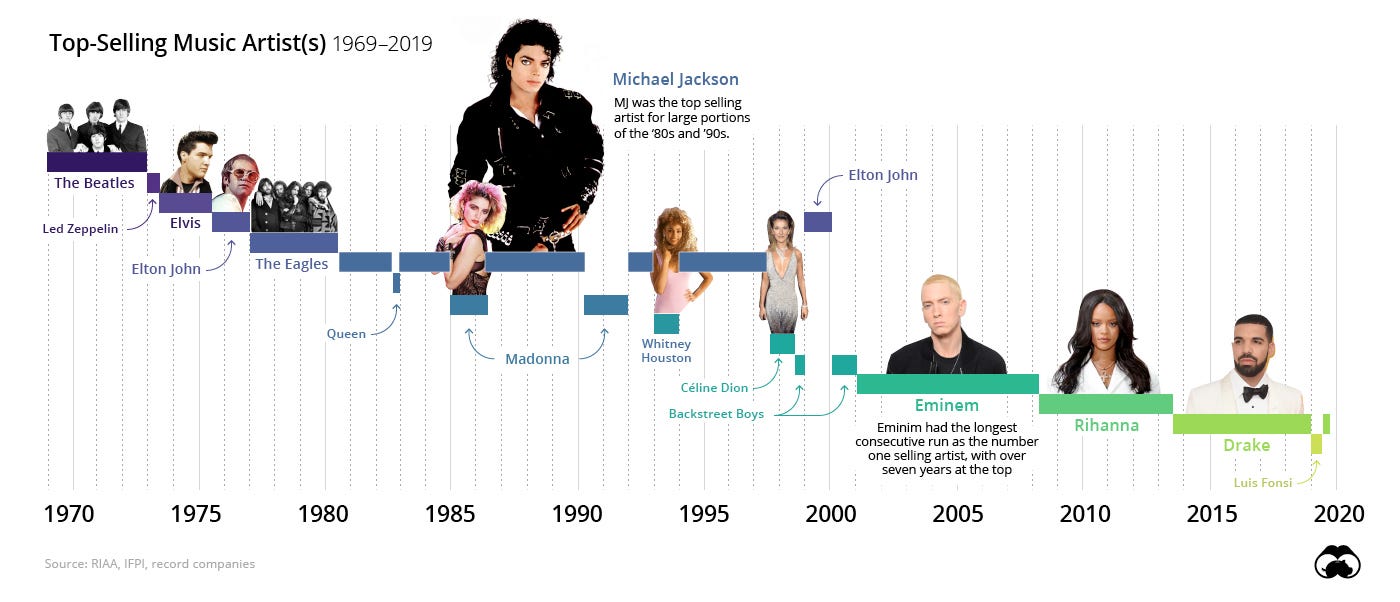
Source: Visual Capitalist (examples of top-selling artists from 1969 to 2019)
Then in 2006, Spotify arrived. It took a few years to gain traction, but eventually it became a mass phenomenon.
Suddenly any artist could self-publish. All you needed was access to a recording studio for a few hours—already a commodity by then—to record, edit, and publish.
The resources to make and distribute music got democratized. A lot more people started distributing music.
Let me use made-up numbers to make the point clearer. It was no longer just a hundred artists selected by producers. Now there were a thousand: a hundred selected by labels, nine hundred self-produced.
But here’s what happened: those nine hundred new entrants didn’t access the market of the original hundred. They got added below.
What you got was a lot of people who don’t earn much, and a lot of people who—in the old system—would never have been considered good enough to get a recording studio.
In other words: the last two decades still produced their outliers—Bruno Mars, Taylor Swift, The Weeknd, Adele, Drake, Ed Sheeran, Justin Bieber. The top didn’t shrink. The bottom expanded.
My friend’s two complaints—“anyone can make music now” and “musicians don’t get paid enough”—are the same thing seen from two different angles.
Both describe new people entering at the bottom. The fact that more people are making music means that more people earn little or nothing. That’s not the market degrading upward. That’s the market expanding downward.
Now, does the arrival of nine hundred new musicians have zero effect on those at the top? No. The market is partly zero-sum: having more participants means the pie gets sliced thinner. But two things are worth noting. First, the impact isn’t evenly distributed—the top absorbs far less damage than the middle and bottom, because demand concentrates disproportionately around a few names—power-law distributions anyone? Second, the pie itself isn’t fixed. As the RIAA data shows later in this piece, the overall market can—and did—grow.
So while the effect is real, it’s not the catastrophe the complaint suggests. And there’s an upside that didn’t exist before: talented people who self-produce at home now have a real chance (small, but real) of being noticed and breaking into the market, without ever having been picked by a label.
Of course, you don’t become successful in a market this competitive by doing nothing. Which brings me to the next point.
Who builds instead of complaining
There’s a band I love called Scary Pockets. Incredible funk group, founded in 2017.
Their founder and keyboard player, Jack Conte, is also the founder of Patreon—the platform that lets creators get funded directly by their audience.
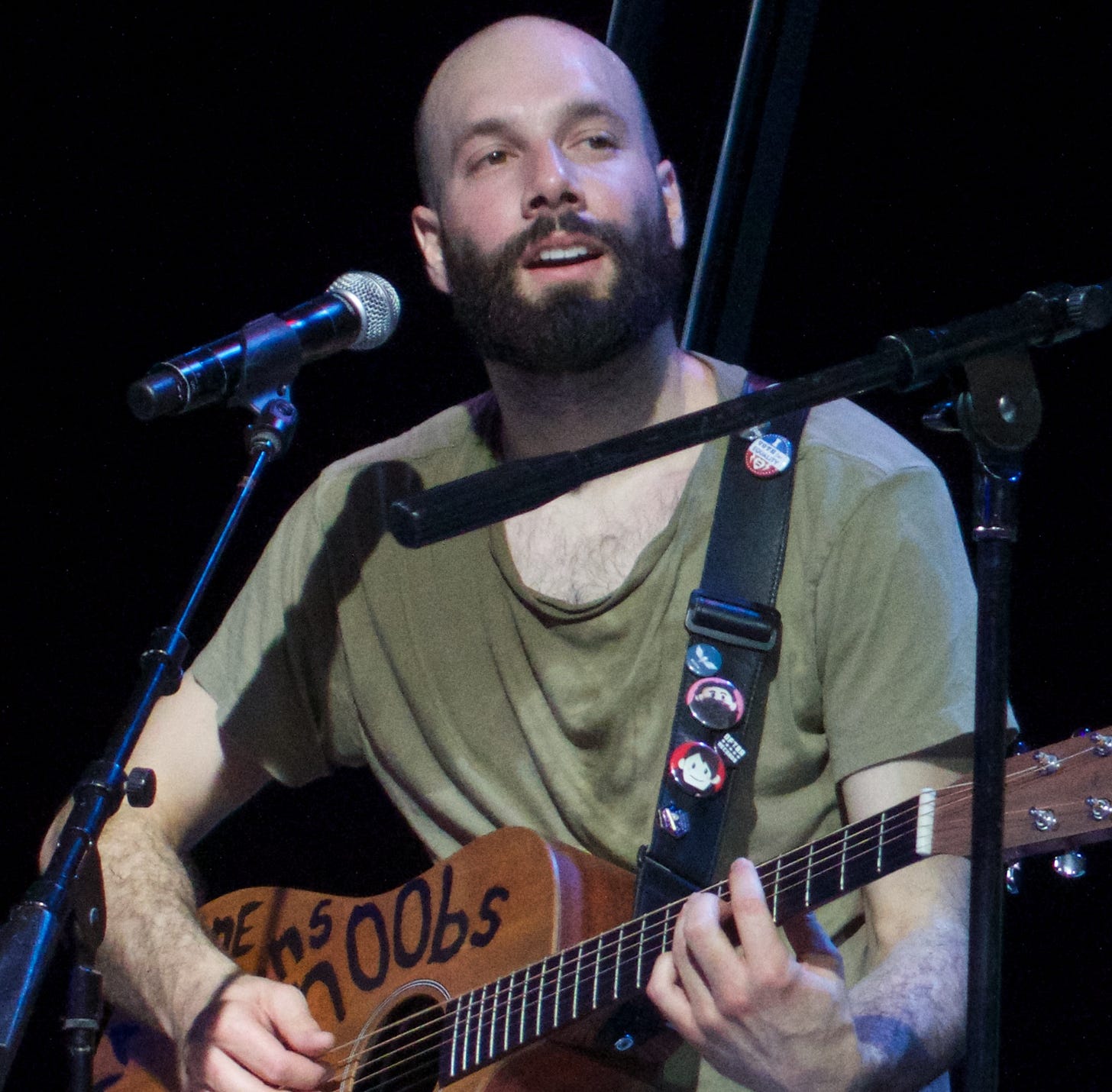
Jack Conte
Think about it.
Jack Conte founded Patreon in 2013—the tool that lets creators bypass the old gatekeepers entirely—and then started Scary Pockets in 2017, in the most competitive era in the history of music.
That’s the difference between someone who complains about being talented but not produced, blaming the horde of barbarians flooding in from Spotify and YouTube—and someone who takes the exact same conditions and builds on top of them.
Because here’s what many musicians miss: musical talent is only one part of being in the music business. And it has always been like this.
I’m the son of musicians. I grew up surrounded by my parents’ musician friends, and then by my own. Watching them—across two generations—I noticed a clear divide. On one side, a lot of them believed that being good at their art was enough to make a living. On the other, there were the professionals: musicians who could play, yes, but who also knew how to manage a repertoire, build relationships, and navigate the industry.
I’ve come to think of this as a general rule, not just for music: your core skill is maybe 30% of your business model. The other 70% is the rest of your business model. Understanding what the client actually needs. Working well with others. Having the judgment to know which direction to invest in, rather than just executing.
In the terms established by Alexander Osterwalder in the Business Model Canvas, being a talented musician is one of the key activities, sure. But like it or not, a musician also has to be a marketer, often a showman, sometimes an entrepreneur. Or, in Jack Conte’s case, a founder.
The real alternative was not existing at all
But there was something else my guitarist friend didn’t see. In the old music industry, he would have been one of tens of thousands of excellent musicians for whom there simply was no room. The market was regulated by labels, owned by labels, controlled by labels. On Spotify, self-producing, he earned little. But in the label-controlled market? In all likelihood, he wouldn’t have earned anything at all. He wouldn’t have existed as a professional musician. Period.
Here’s the paradox: the democratization of resources means that people who can now earn a little start complaining about earning a little—instead of realizing that the alternative, in the closed market, was earning nothing at all!
And let’s be honest: being talented is not a sufficient condition for success. There are thousands—hundreds of thousands, millions—of good musicians today. Could you listen to all of them? No. Could any record label produce all of them? No.
Being good—I would say excellent—is a sine qua non. Necessary, but not sufficient. The world is full of people who are talented. Moreover, it’s full of people who think they’re talented.
“It’s not fair anymore”
So why does the complaint work? Why does it sound so convincing? Why do so many people make it? Because two specific cognitive mechanisms are at play.
Loss aversion.
A question for you: is it better to have no access to the market at all, or to have access and see that you’re paid little because you’re not appreciated enough?
Rationally, the second option is clearly better. But the human mind is not always rational.
Which scenario gives you a stronger sense of loss? The second one. Because in the first, you don’t even get in. You don’t finish last in the league—you never enter the league. You don’t become a musician; you go work a desk job. And you don’t suffer, because there’s nothing to compare against.
In the second scenario, you’re in. You see who earns more than you. You may see people with less talent getting more visibility. Opportunity gives you pain. You could call it FOMO, if you like. But that second scenario is objectively better. At least you get to try.
Availability bias.
The data point “I earn little” is right there in front of your eyes. It’s in the sales report that platforms give you. You see it every month, every quarter, every year. It’s an easy story to tell yourself.
The counterfactual—“if the market had stayed closed, I wouldn’t have earned little; I would have earned nothing, because the label would have never picked me”—you can’t see that. It’s not a data point. It’s not a story. It’s an invisible hypothesis.
Before, you couldn’t even appreciate not being appreciated, because someone decided you simply wouldn’t exist. Today you exist and nobody cares about you: you see it and you suffer.
The crowd of struggling artists in 2026 is visible. The crowd of potential artists in 1976, who would have gotten a white-collar job instead, wasn’t.
The crowd is visible. The counterfactual isn’t. That explains the psychology of the complaint. But there’s also a structural question worth asking: if something becomes easier to access, does the quality at the top actually get worse?
Guitar vs. violin
Guitar and violin are two very different instruments.
Anyone can play the guitar. In a single day, you can learn a few chords and play a campfire song. Campfire songs are selected based on exactly this criterion: you can learn them in three hours.
The violin is different. It takes months of daily practice to produce a decent note, and years to learn to play a complete piece. The barrier to entry is enormously higher.
And yet the best violinists and the best guitarists can both reach extraordinary levels.
To make the point with intentionally simplified numbers: a hundred people play the violin and ten become world-class. A hundred thousand people play the guitar, a hundred play it professionally—because the market selects the crème regardless—and ten become Jimi Hendrix, Brian May, Steve Vai, Eric Clapton, Mark Knopfler…
The point is: adding people at the bottom end doesn’t necessarily change the quality at the top.
Now, the predictable objection: “Sure, but before, people could actually make a living playing music. Now there are too many guitarists.”
Let’s do the math. Say 100 professional guitarists can make a living in the market. If 150 try, you have 100 who make it and 50 who say: “I could have been a guitarist, but the market didn’t give me a chance.” If 1,000 try, you have 900 that the market selects out. If a million try, 999,900 don’t get selected and 100 remain professionals.
The number at the top doesn’t change. The number of people who try does.
So far, we’ve looked at all of this from the producer’s side—who makes music, who competes, who survives. But what about the other side? What about the listener, the person who actually consumes music? Is the experience worse?
The quality is still there. And the market is not dead.
The fact that music is now flooded with poor quality doesn’t take anything away from the fact that the quality is still there—and can still be found.
And this is the key point: if quality is findable, a market where you can search for it among a thousand options is better than a market where someone else picks it for you.
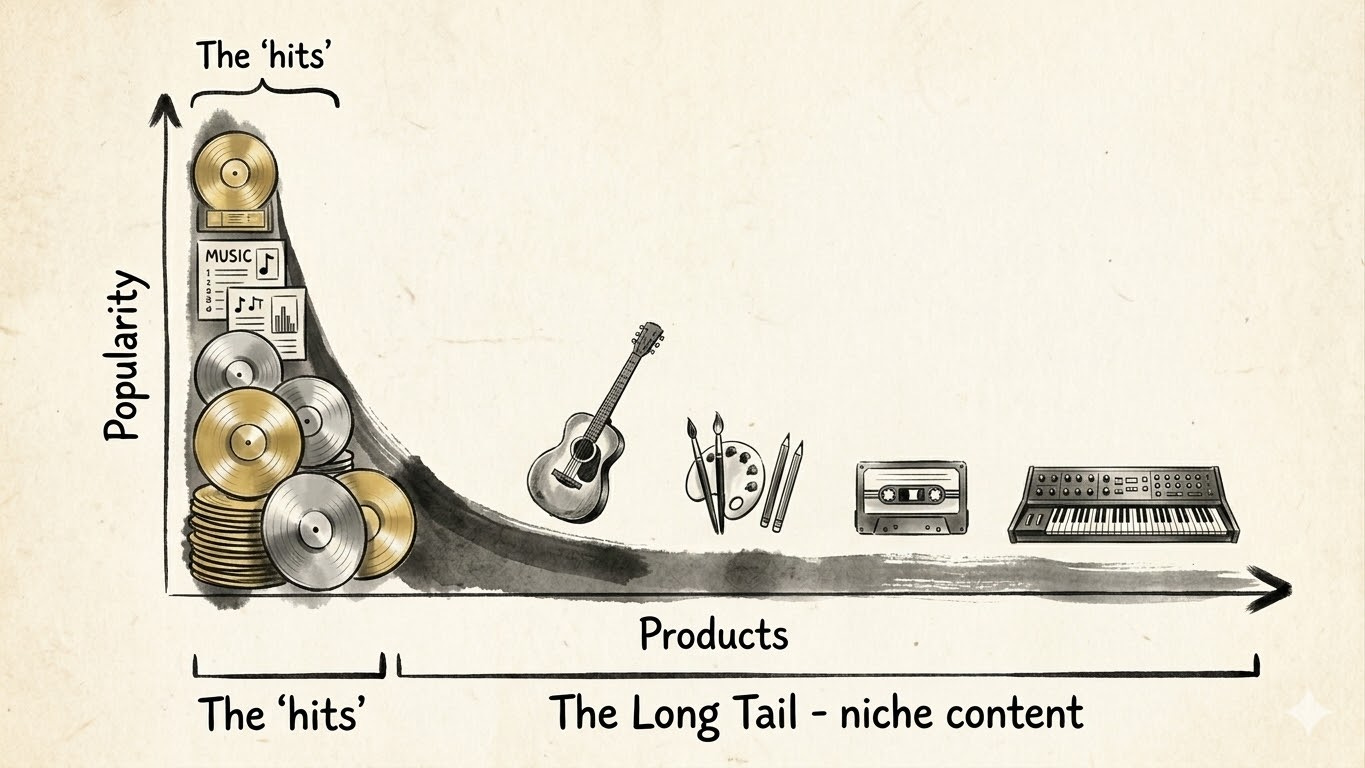
Chris Anderson explained this years ago in “The Long Tail”: when distribution costs collapse, the market gets longer. The tail stretches out. Quality doesn’t go down.
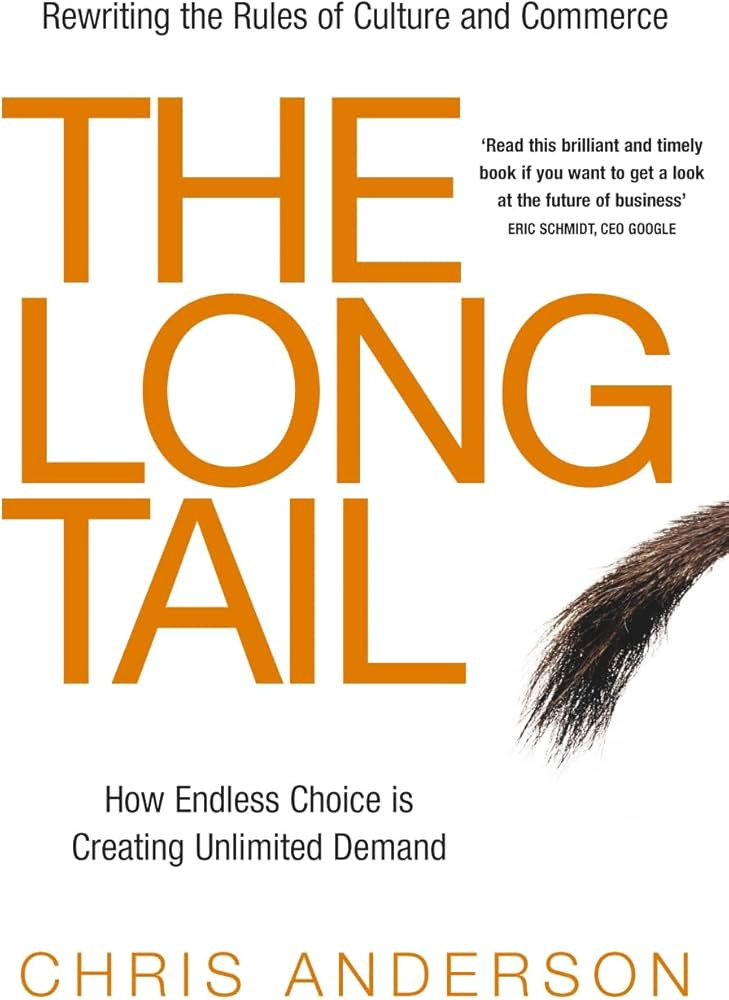
“The Long Tail” book cover.
The numbers confirm it. After the digital disruption of the early 2000s, the music market crashed. Everyone declared it dead. It went from a peak of roughly $25 billion (inflation-adjusted) in the late ‘90s to less than $8 billion by 2014. And then streaming brought it back. Today it’s at around $20 billion—its second-highest level ever—and still growing.
The market didn’t die. It contracted, restructured, and came back. The top artists today—The Weeknd, Lady Gaga, Taylor Swift—still make enormous amounts of money. The number of top artists hasn’t decreased.
Before, it was the best ten out of a hundred. Now it’s the best ten out of maybe a million. But from the hundred-and-first to the millionth, you added them at the bottom. You didn’t dilute the ones at the top.
The market is bigger. There are more participants. And high-quality output is still there.
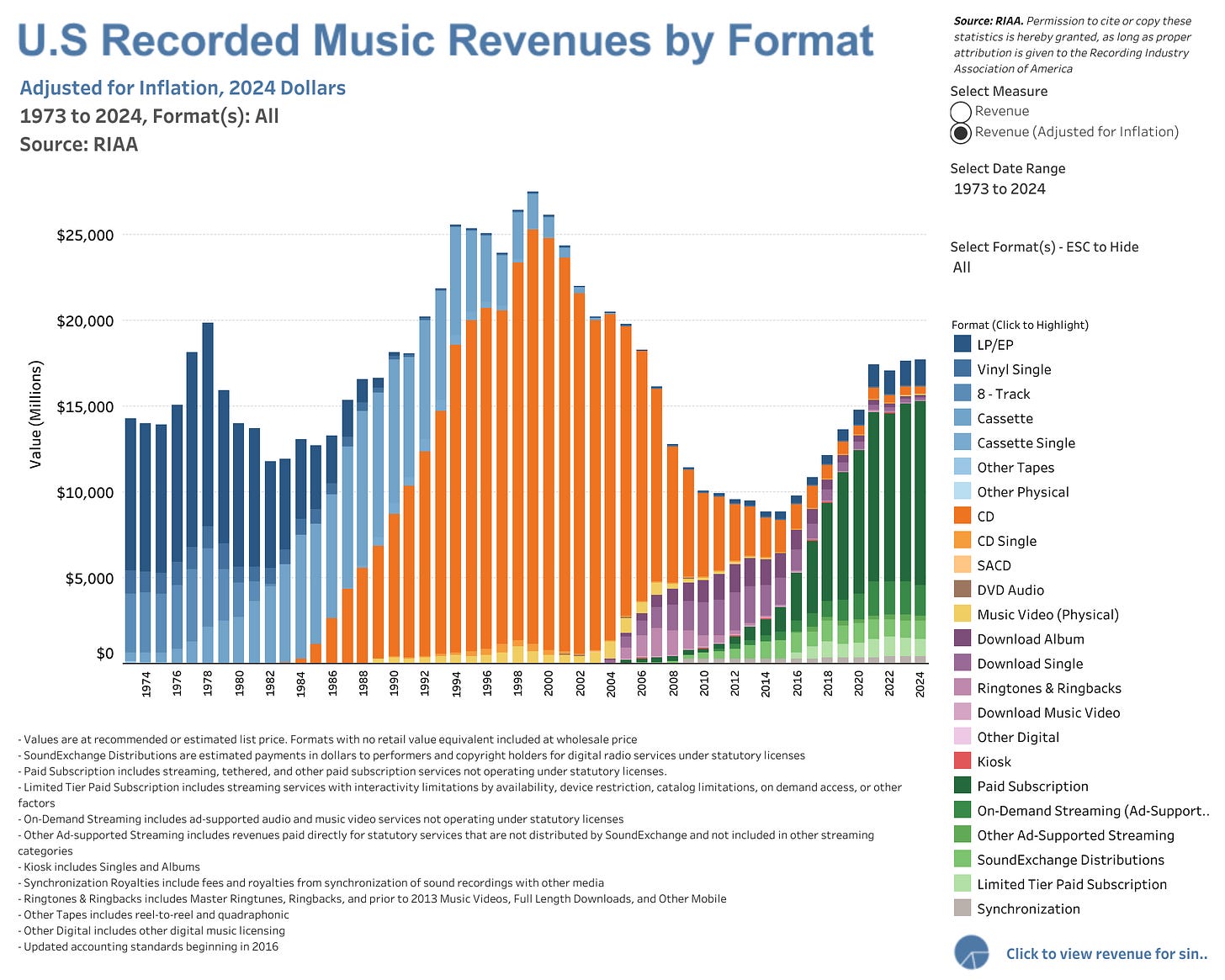
Source: RIAA. Values adjusted for inflation (2024 dollars).
But this doesn’t only apply to the music industry.
Expanding markets everywhere
What happened to the music market with Spotify is, I believe, about to happen to every market that involves creative or intellectual production—what we’d broadly call knowledge work—thanks to AI.
There’s a phrase you hear all the time, at least in my bubble of developers and ex-developers:
“Yeah but now with AI, everyone can code!!”
Yes. It’s true. Everyone can code.
This means there will be a ton of bad code out there. But again: that bad code gets added to the quality that was already there. It doesn’t replace it.
Those who coded well will keep coding well. In fact, they’ll do it better—because they can spend less time on the mechanical activity of writing code (their key activity) and more time on what actually matters: architecture, system design, UX, UI. In other words: less time producing code, more time solving problems (their real value proposition). Those who build intelligent software, who create intelligent products—those products will still be there.
Exactly like the fact that the guitar is easier than the violin takes nothing away from the market of Al Di Meola, Paco De Lucía, Brian May.
A new market just opened up. Everyone’s jumping in. There will be a lot of junk.
But high-quality work will still be there.
If we all accept that strumming a guitar is a right we all have and that it takes nothing away from the quality, the success, the recognition of Brian May—and if we accept that the arrival of twenty new vibe coding tools takes nothing away from top professionals—then there’s no need to treat every market that becomes easy to access as a threat.
And if you’ve spent your whole career never updating your skills, never improving the quality of your code, thinking only about writing code instead of solving users’ problems—the issue is upstream.
Good news: this AI revolution helps you too, because it lets you catch up faster.
Peace,
Jacopo Romei
Thanks for reading Jacopo Romei // The Sweep! Subscribe for free to receive new posts and support my work.